Industrial Master Planning for Functional Campus Design
We approach master planning as a structural and spatial exercise, not just a site layout. This factory campus in Dodballapur integrates complex production workflows with human-centric spaces.
A video montage providing a comprehensive tour of the Ajax Engineering campus in Dodballapur. It highlights the key architectural elements, the flow between buildings, and the successful integration of industrial function with a human-centric environment.
The cafeteria and cloakroom building at the Ajax campus, designed with a distinctive cantilevered form. This structure serves as a key social hub and is positioned to be easily accessible while maintaining the overall aesthetic of the master plan.
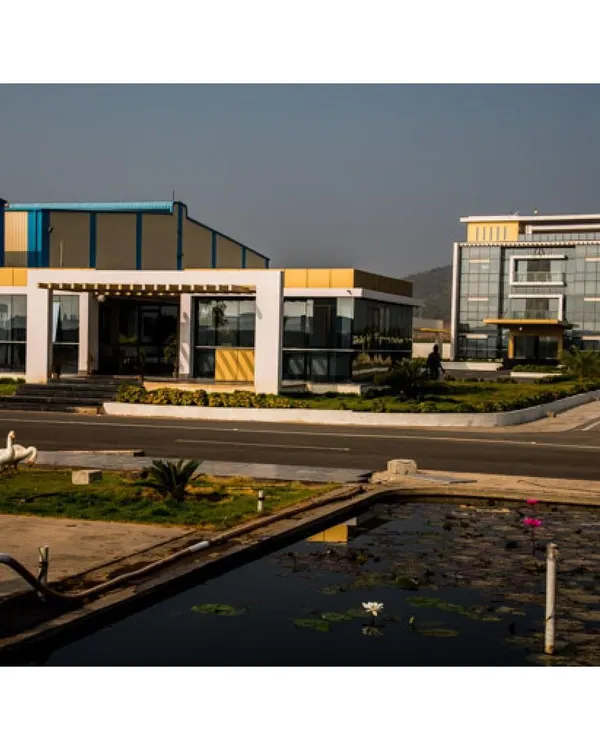
A view across one of the central courtyards, showing the relationship between the different building blocks. These planned open spaces, or "pause points," are essential for breaking the scale of the industrial campus and introducing natural elements.
The facade of the cafeteria building, seen from its adjoining lawn. The design uses large glass panels on the ground floor to create a visual connection with the landscape, while the staggered windows on the upper floor provide controlled light and privacy.
This elevated bridge is a primary example of our campus connectivity strategy in action. It physically and visually links different zones of the facility, allowing for efficient movement of people and materials above the ground-level vehicle traffic.
The main office block, featuring a multi-level facade with deep-set windows and balconies. This design responds to the climate by providing shade and creates a formal yet inviting presence as part of the campus master plan.
The primary pedestrian approach to the office building. The pathway is intentionally framed by manicured hedges and lawns, creating a formal procession that emphasizes the transition from the open campus to the corporate workspace.
A detailed view of the interconnected circulation network. This image shows how a person can move seamlessly from an exterior walkway, across a bridge, and into the building's vertical core, illustrating the fluid design of the campus layout.
The central circulation hub where bridges and staircases converge. The exposed truss work of the bridge and the sculptural form of the stairs are an honest expression of the structure, turning a functional necessity into a primary architectural feature.
The interior of the cafeteria, where minimalist design and controlled natural light create a tranquil environment. The horizontal slit windows are a recurring motif from the exterior, providing glimpses of the outside while minimizing direct glare.
About Ajax Engineering Campus: A Case Study in Industrial Master Planning
We utilized the site’s natural contours and tapered shape in Dodballapur to avoid standard, boxy planning. Instead of pushing buildings to the edges, we introduced green pause points and elevated bridges to link the production floor, office, and cafeteria. This creates a campus that functions as a single, connected organism rather than a collection of isolated blocks.
Our Approach to Master Planning
For us, master planning is about making a world that actually fits. Whether it is a factory, a training center, or an office campus, everything starts with a strong conceptual idea that informs every walkway, corner, and open patch. We do not force the land to fit the plan. Instead, we spend time figuring out what makes the site tick, including its topography, history, and surrounding context.
Industrial & Corporate Strategy
In projects like the Ajax Engineering campus, we focus on several key pillars:
- Logistics Planning: We segregate heavy goods vehicle routing from employee traffic, ensuring safety and operational efficiency.
- Campus Connectivity: We use physical connectors like bridges and walkways to prevent the siloed feel common in industrial parks.
- Topography & Zoning: We analyze slope and gradients to minimize cut and fill costs. Functional blocking ensures that production zones, utility areas, and admin units are placed for optimal workflow.
- Nature Integration: Green pockets and courtyards are not just decorative. They act as pause points, providing necessary breathing room that prevents a large campus from feeling like a concrete desert.
Why This Matters
Architectural integrity comes from letting materials be themselves. Whether it is concrete in its raw form or steel that serves as a sculptural element, the design should reflect its core purpose. We plan for buildings and nature to grow together, ensuring the space remains functional as your operations change over time. If you have an industrial site or a large campus project, let us discuss how to align your logistical requirements with a cohesive architectural vision.
Similar work from other experts
Browse through Curated picks from other experts on mytribe
 11
11
Industrial Campus Architecture & Design
 12
12
Industrial Architecture: Efficiency & Scale
 26
26
Designing Integrated Corporate Campuses & IT Parks
 17
17
Institutional and Campus Architecture
 18
18
Design for Campuses for Innovation & Well-being
 14
14
Educational and Institutional Campus Master Planning
More from Master Planning by Funktion Design
More services by Funktion Design