Learning Mathematics Through Discovery and Wonder
At The Earth School, mathematics is not a collection of problems to be solved in a workbook. It is a universal language, spoken through hands-on projects and the joyful rhythm of discovery.
A child works on a long timeline, gluing paper upon paper to map out vast stretches of history. This kind of "big work" allows her to physically grasp the scale of time and connect different historical events in a meaningful way.
This child was so engrossed in her long division work that she spent three hours on it and still wanted to continue the next day. This is what self-chosen rigor looks like, driven by an internal desire to master a concept.
A close-up of the meticulous calculations involved in a massive long division problem. The child is not just finding an answer; she is exploring the process, checking her work, and experiencing the deep satisfaction of sustained focus.
"A polygon with 59 sides." This chalk drawing on the pavement is the result of a collaborative project to build a mammoth polygon. Learning spills out of the classroom and becomes a public declaration of discovery.
A child's notes on finding the pattern in the difference between successive cubes. This is the heart of mathematical thinking: not just calculating, but searching for patterns and making discoveries.
Younger children are introduced to multiplication using the golden beads. This classic Montessori material makes the concept of exchanging units for tens and tens for hundreds a concrete, physical action they can see and touch.
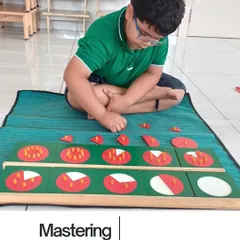
A child holds a complete set of Montessori fraction circles. These beautiful, hands-on materials allow children to explore the relationships between parts and the whole in a tactile, intuitive way.
A tower of wholes. The children discovered how many tenths, ninths, and other fractions make a whole by stacking the pieces. This playful exploration builds a strong conceptual foundation for later work with fractions.
More scenes of mathematics in action, from children measuring themselves against a chalkboard to creating secret rooms of math puzzles. These images show how math is a joyful, creative, and collaborative language at our school.
More scenes of mathematics in action, from children measuring themselves against a chalkboard to creating secret rooms of math puzzles. These images show how math is a joyful, creative, and collaborative language at our school.
About The Language of Mathematics
You will not find our students passively filling out worksheets or memorizing abstract formulas. Instead, you might see a child spending three hours meticulously working through a long division problem or a group collaborating to draw a massive 59-sided polygon on our pavement. This is what we call self-chosen rigor. By using concrete Montessori materials like golden beads and fraction circles, children build a mathematical foundation that feels real and tactile, turning abstract concepts into tools they can physically manipulate and understand.
Mathematics in our elementary program is woven into what we call 'Cosmic Education'. We treat math as a creative discipline where students explore the patterns of the universe. When children engage with our prepared environment, they are not just learning to calculate; they are learning to observe, verify, and question.
The Materials as Teachers
We rely on classic, specialized Montessori apparatus designed to make concepts visible. For instance, our golden beads help children understand the decimal system and the process of carrying and borrowing long before they write down an equation. Our fraction circles turn the often-dreaded study of parts and wholes into a playful, interactive experience where children literally stack 'pizza' pieces to discover their relationships.
Big Work and Timelines
Our approach is grounded in 'Big Work' projects that span days or weeks. Children glue vast trails of paper to map out centuries of history, exploring the scale of time alongside the math required to measure it. Whether they are calculating the differences between successive cubes or measuring their own growth against a chalkboard, they are constantly applying their mathematical minds to the world around them.
Moving Beyond Textbooks
We believe that early exposure to rote learning can stifle natural curiosity. By removing the pressure of textbooks and rigid schedules, we allow children to develop fluency at their own pace. They discover that math is not just for the classroom; it is a tool for understanding their community, managing our daily tasks, and organizing their own creative projects. In our multi-age classrooms in Cooke Town, the older students frequently mentor the younger ones, reinforcing their own understanding while building a collaborative spirit.
Similar work from other experts
Browse through Curated picks from other experts on mytribe
Montessori Mathematics: Hands-on Learning for Kids
 8
8
Hands-On Montessori Learning for Children
 59
59
Hands-On Montessori Learning: How Children Build Real Skills
Montessori Language & Math: Hands-On Learning
 66
66
Learning by Doing: The Montessori Way
Montessori Academic Foundations in HSR Layout
More from Montessori Primary & Elementary Program by The Earth School
More services by The Earth School