The Drawing Process: From Blank Page to Art
Progress isn't a straight line, and it's definitely not pretty at the start. Here is the raw journey of how I build my drawings, from the first messy lines to the final details.
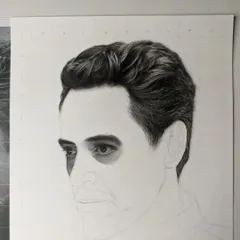
A work-in-progress shot of a realistic portrait of Zakir Khan. You can see how I build up the skin texture and features on one side while the other side is still a basic line drawing.
Another stage of the Zakir Khan portrait. Here, the focus is on rendering the eye and the surrounding area with hyper-realistic detail, which requires careful layering of graphite.
This WIP shot focuses entirely on drawing realistic hair. I started by blocking in the darkest areas and then slowly pulled out individual strands and highlights to create that sense of volume and flow.
The beginning of a commission portrait. I start with a light sketch to get the placement and proportions right before committing to darker shading. This one is laid out on a cutting mat which helps with alignment.
The same commission work, a little further along. I've started to add shading to the face to build up the three-dimensional form, working from light to dark with different grades of pencils.
An identical shot to the previous one, showing the steady, careful process of building up layers in a realistic graphite portrait.
The first work-in-progress shot of my Rabindranath Tagore portrait. I always start with the eyes, as they are the key to capturing the subject's essence. The grid lines help maintain accuracy.
A close-up of the Tagore WIP. You can see the detailed rendering of the eyes and forehead, contrasting with the untouched lower half of the drawing. This shows the patience required for realism.
This video shows the shading process on a portrait. I use brushes and pencils to blend the charcoal and graphite smoothly, slowly building up the shadows to give the face depth and realism.
A different angle of the same work in progress. It shows how I use different tools, from sharp pencils for details to brushes for soft blending, to bring a portrait to life.
About The Drawing Process: From Blank Page to Art
Every realistic portrait starts with the Loomis method—a grid of lines that look nothing like a face at first. I show these stages because, honestly, progress is messy. Most people only see the final hyper-realistic detail, but the real work happens in these rough construction lines where proportions are set and mistakes get fixed before they become permanent.
Realism is a game of patience, not just talent. Whether I am using graphite, charcoal, or a ballpoint pen, the process remains the same: I build from light to dark, layering values to create depth. You will notice in my process shots that I often start with the eyes or the most complex features. Capturing the essence of a subject like Rabindranath Tagore or a client in a commission piece requires this slow, deliberate build.
I don't believe in the 'overnight success' myth. My drawings often take days, sometimes weeks, to finish. I use fine-liners for cross-hatching to get that perfect texture, and brushes to blend charcoal smoothly into the paper. This isn't just about making a pretty picture; it's about solving the problem of form, light, and shadow. If you are interested in seeing how a specific portrait comes to life or want to commission a piece that captures your own vibe, that is where we start. Let's turn your photos into something real.
Similar work from other experts
Browse through Curated picks from other experts on mytribe
 24
24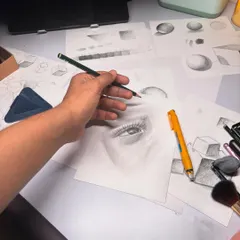
My Process and Practice
Behind The Art: My Sketching Process
The Artistic Process: From Sketch to Finish
 18
18
Behind the Scenes: My Art Process & Studio
Learn Realistic Pencil Portrait Drawing (Step-by-Step)


Behind the Art: My Sketches & Timelapses
More from Art Workshops & Classes by Tarun Kumar
More services by Tarun Kumar