Pranayama and Mudras: Mastering Your Life Force
Breathing is not just a physical act, it is your life force. At my studio in Vile Parle, we focus on the science behind Pranayama and Mudras to help you channel energy, calm the mind, and deepen your practice with precision.
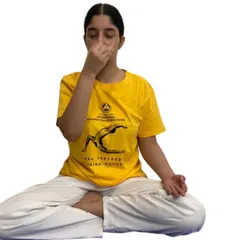
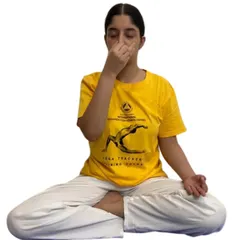
Students in my class are practicing Bhramari Pranayama, also known as the bee breath. This powerful technique involves creating a humming sound on the exhale to calm the nervous system, reduce anxiety, and improve mental clarity.
Bhramari Pranayama is a calming breathing technique that mimics the buzzing of a bee. It is often practiced with Shanmukhi mudra to enhance its effects, promoting inner peace and emotional balance.
An introduction to Bhramari Pranayama, or 'the bee breath'. Regular practice of this technique can significantly improve sleep quality and activate the parasympathetic nervous system, which is responsible for the body's rest and digest functions.
This graphic explains the fundamental concept of Mudras. They are symbolic hand gestures used in yoga and meditation to channelize energy and facilitate the flow of prana, or life force, in the body.
Here are five key benefits of practicing Mudras. They contribute to physical health by balancing the body's elements, improve mental well-being by calming the mind, and support spiritual growth by aiding in meditation.
This infographic illustrates how the five elements of nature, fire, air, space, earth, and water, correspond to the five fingers of your hand. This ancient concept is the foundation for understanding how Mudras work.
A detailed look at the five elements and their corresponding fingers. The thumb represents fire for energy, the pointer finger represents air for intellect, and so on. Combining these fingers in different Mudras helps to balance these elemental energies within you.
About Pranayama & Mudras: Mastering Your Life Force
Most people try to force their breathing, but that is the wrong approach. When we practice Bhramari Pranayama, the humming sound is not just noise—it is a vibration that clears internal blockages. You need to understand how to sit, how to position your fingers in Shanmukhi Mudra, and why the exhale must be longer than the inhale. If you do not understand the mechanism, you are just moving air, not managing your prana.
Pranayama is the control of life force, and Mudras are the circuits that direct it. In my sessions, we break down the ancient wisdom that is often lost in modern fitness-focused yoga.
The Science of Mudras
We look at the hand as a map of the five elements. The thumb is fire, the pointer finger is air, the middle is space, the ring is earth, and the little finger is water. By connecting these fingers in specific gestures, you are creating a circuit that balances these elements within your body.
Why Technique Matters
Whether it is the Bhramari Pranayama (bee breath) for sleep or specific mudras to ground your energy, the placement matters. If your posture is hunched, the flow of energy—your prana—gets stuck. I don't just tell you to hold a pose. We work on the subtle details:
- Spine alignment: Ensuring the energy flows upwards, not downwards.
- Exhalation focus: Understanding why forward bends require an exhale and backbends require an inhale.
- Parasympathetic activation: How to use breathwork to physically shift your body out of a stress response.
This is not about surface-level exercise. This is about understanding your own biology and using breath as a tool to calm anxiety, improve focus, and build mental clarity. If you are tired of generic classes that do not explain the 'why' behind the movement, this is where you start.
Similar work from other experts
Browse through Curated picks from other experts on mytribe
The Power of Breath and Mudras
Master Pranayama, Mudras and Meditation Techniques
 14
14Powerful Mudras and Pranayama for Daily Balance
 5
5
Pranayama Workshops for Breath Control and Energy
Mastering the Science of Breath and Meditation
Mastering Pranayama: Traditional Breathwork at Aikia Yogashala
More from Yoga Teacher Training Course (YTTC) by Aarti Purohit
More services by Aarti Purohit