Mastering Montessori Math Concepts
Math is not a subject to be memorized, but a language to be spoken. In our classrooms, children use concrete materials like the Stamp Game and Spindle Box to build a deep, intuitive understanding of numbers before they ever touch a textbook.
With the Spindle Box, children learn the fundamental concept of quantity and the meaning of zero. Our training will show you how to present this material to build a child's counting skills, organization, and focus.
Adding it all up the Montessori way. The addition strip board allows children to physically combine numbers and see the process of addition, turning an abstract calculation into a concrete and understandable activity.
The Short Bead Stair is a beautiful, hands-on tool for teaching number relationships and sequencing. You will learn how to guide children through this activity, helping them build a deep, tactile understanding of numbers 1 through 9.
The Stamp Game is a brilliant material for teaching the four mathematical operations. Our course provides in-depth training on how to use these stamps to represent units, tens, hundreds, and thousands, making complex math accessible.
Even complex geometry can be explored at a young age. The Square of Pythagoras is a sensorial puzzle that indirectly prepares the child's mind for later mathematical concepts, demonstrating the genius of the Montessori method.
This is algebra for a five year old. The Trinomial Cube is a sensorial puzzle that represents the algebraic formula (a+b+c)³. You will learn how to present this material as a fun challenge that prepares the brain for advanced mathematics.
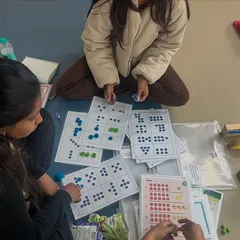
All math learning begins with the basics. The Cards and Counters material is a foundational activity you will master, teaching children to associate quantity with number symbols in a clear and orderly way.
About Mastering Montessori Math
You might see a five-year-old solving algebraic formulas with a Trinomial Cube or exploring place value through the Stamp Game. This is not early academic pressure, but the result of using precise, tactile materials that translate abstract symbols into physical quantities. When a child holds a bead or counts a spindle, they are not just learning to calculate; they are building a mathematical mind that understands the logic beneath the numbers.
From Concrete to Abstract
The journey of a child’s mathematical mind begins with what they can touch. In a Montessori environment, we do not start with written numbers on a page. We start with the Spindle Box to teach the concept of quantity and zero, or the Cards and Counters to associate symbols with groups of objects. This foundational work ensures that when a child eventually moves to abstract concepts like addition or multiplication, they already have a deep, internal 'feeling' for what those numbers represent.
Why Our Teacher Training Focuses on Math
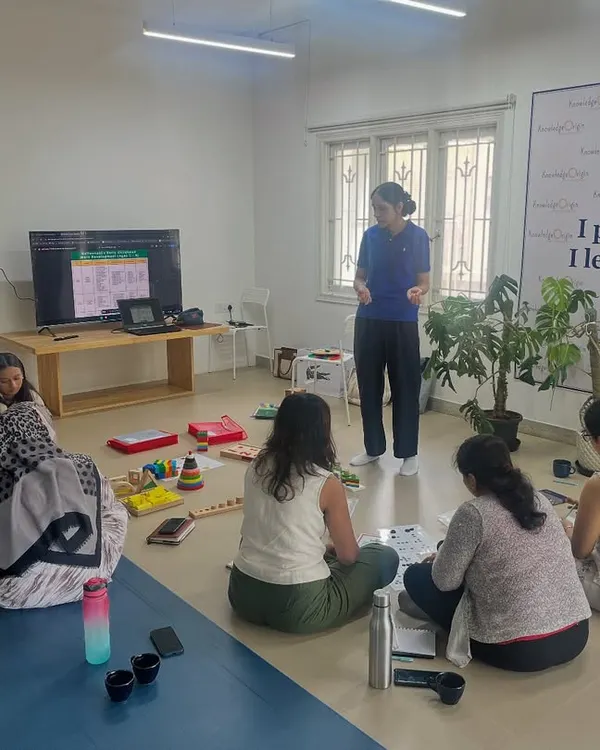
We believe that to teach math, you must first understand the purpose of the material. Our training programs in Bangalore—both our 5-month online certificate and 10-month offline diploma—go beyond just showing you how to present a lesson. We help you understand the child's developmental path.
- Sensorial Integration: Using tools like the Square of Pythagoras to indirectly prepare the mind for future geometry.
- Language of Math: Learning how to articulate math concepts clearly so that children can follow the logic of the material independently.
- Precision and Order: Understanding why the physical environment, from the placement of the addition strip board to the storage of beads, matters to the child's focus.
Whether you are an aspiring teacher or a parent wanting to guide your child better, mastering these materials is about fostering a lifelong confidence in logical thinking.
Similar work from other experts
Browse through Curated picks from other experts on mytribe
Montessori Language & Math: Hands-On Learning
 8
8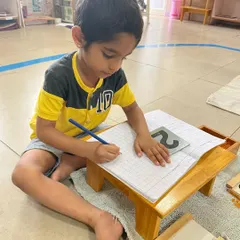
Hands-On Montessori Learning for Children


Mastering Montessori Through Hands-On Materials
Montessori Academic Foundations in HSR Layout
 4
4
Early Numeracy Professional Training for Educators
 20
20
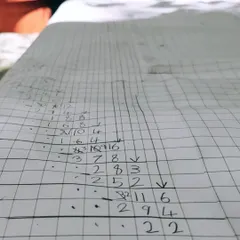

Learning Mathematics Through Discovery and Wonder
More from Montessori Teacher Training by Dots Montessori
More services by Dots Montessori