Understanding Maintenance and Alimony Laws
Maintenance isn't a fixed percentage or a set formula. Courts calculate it based on real lifestyles, income capacity, and specific financial needs. Know your rights before you make your first move.
If a trial court passes a maintenance order against you that you feel is unfair, do not lose hope. This is not a final order. You have the right to appeal in the Sessions Court and then the High Court to correct any factual or legal errors.
A husband's lifestyle is a key factor in deciding maintenance. In a recent case, the Jaipur Family Court ordered a husband to pay maintenance of Rs 22,500 just by looking at the fact that he uses an iPhone.
The Allahabad High Court has ruled that a healthy and able-bodied husband is duty-bound to maintain his wife. He cannot escape this responsibility by claiming he is unemployed, as he can still work as an unskilled laborer.
The Supreme Court has set a major precedent. It ordered a husband to sell his ancestral property to pay Rs 1.25 crores in maintenance arrears to his wife, using its inherent powers under Article 142.
Section 125 of the CRPC has been replaced by Section 144 of the BNSS. If you are a wife or have a child and are not being given money for basic necessities, you can use this provision to approach the court for maintenance.
A wife is not always entitled to maintenance. The court can deny it if she is living in adultery, has left her husband without a valid reason, is professionally qualified and capable of earning, or earns more than her husband.
Proving adultery to deny maintenance can be difficult. However, the Punjab & Haryana High Court has ruled that husbands can use social media evidence like photos and videos to support their claims.
As per a Jharkhand High Court ruling, a wife who is living away from her husband without any reasonable cause is not entitled to receive maintenance.
If a wife is well-qualified and earning enough to support herself, the court may deny her claim for maintenance. However, the husband is always liable to pay for the maintenance of the child, regardless of the wife's income.
About Understanding Maintenance & Alimony
Many people panic over initial maintenance orders, thinking the amount is final. It is not. There is no set legal formula for maintenance. Courts perform a detailed assessment of both parties, looking at actual bank statements, spending habits, and earning capacity. I often see cases where trial court orders are based on incomplete information. If you feel an order is unfair, or if you are facing exaggerated claims, you have clear legal paths to challenge or appeal these orders in higher courts.
The Reality of Maintenance Calculations
There is a common misconception that maintenance is a specific percentage of the husband's salary. This is false. Whether you are seeking maintenance or defending against an unfair claim, the court evaluates a broad spectrum of evidence. This includes income affidavits, bank records, lifestyle indicators—like vehicle ownership or spending patterns—and professional qualifications.
Why Evidence is the Foundation
I always tell my clients: don't just state facts, prove them.
- Lifestyle Evidence: If a husband claims he has no income but maintains a luxury lifestyle, your evidence needs to capture that.
- Earning Capacity: If a wife is professionally qualified and choosing not to work, we present this to the court.
- Digital Proof: Courts are increasingly relying on social media records, WhatsApp chats, and call logs to determine the true nature of the relationship and financial independence.
Challenging Unfair Orders
If a trial court passes an order that feels disconnected from the facts, remember that you have the right to file an appeal in the Sessions Court or the High Court. Many clients give up too early. My goal is to ensure your financial standing is protected by highlighting factual or legal errors that may have been overlooked during the initial proceedings.
When is Maintenance Denied?
It is important to know that maintenance is not automatic. Courts can and do deny maintenance if:
- The wife is living in adultery (which can be proven with solid evidence).
- The wife has left the matrimonial home without a reasonable cause.
- The wife is earning equal to or more than the husband.
If you are stuck in a matrimonial dispute, don't let silence or lack of preparation weaken your case. From Section 125 CRPC to the new provisions under BNSS, navigating these laws requires a strategic approach from day one.
Similar work from other experts
Browse through Curated picks from other experts on mytribe
Understanding Maintenance & Alimony Laws
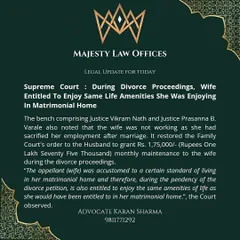
Maintenance Claims and Defenses in India
Understanding Maintenance, Alimony, and Property Rights
Maintenance and Alimony: Understanding Your Financial Rights

Maintenance and Alimony Laws: Expert Legal Advice in Delhi
 18
18

Maintenance and Alimony Rights in Delhi
More from Family & Matrimonial Law by Kanika Bhardwaj
More services by Kanika Bhardwaj