STEAM Concepts Made Real Through Hands-On Play
Transform abstract STEAM lessons into physical reality. Watch as simple wooden planks teach children gravity, geometry, and structural engineering—without a single screen in sight.
BASIC MATHEMATICS! We all have an inherent ability to estimate and calculate. When building this square tower, the creator is using "eyeballing" to judge distance and ensure the planks are placed correctly, applying geometric concepts without a ruler.
RISK! The domino run is a perfect lesson in cause and effect. It takes focus and precision to set up, and there's always a risk it could fall prematurely. This teaches children about taking calculated risks and the satisfaction of seeing a chain reaction succeed.
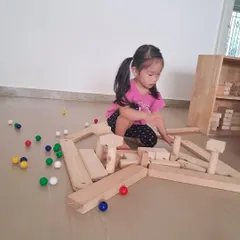
OPEN ENDED PLAY! This child has combined our wooden planks with colorful dominoes to create a vibrant cityscape. This is what open-ended play is all about: there are no rules, allowing for infinite creativity and self-expression.
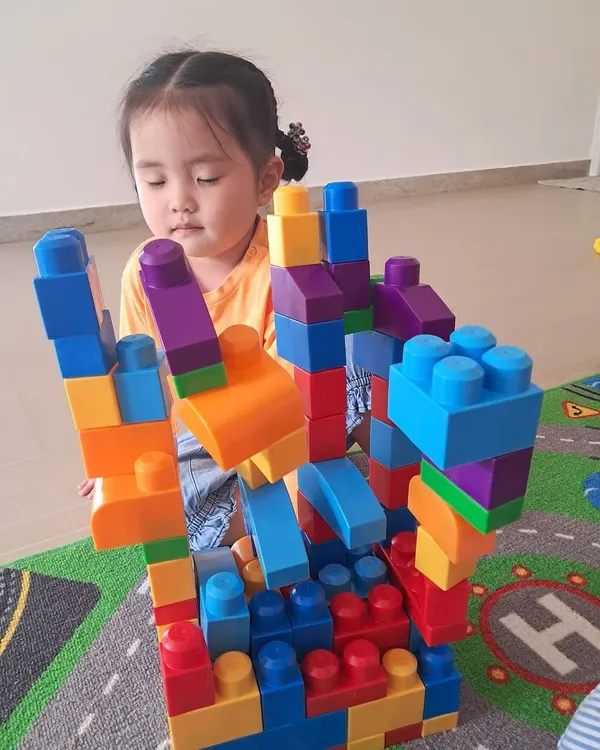
GOAL SETTING! Building a complex structure like this requires a clear goal. The builder first visualizes the end product, then breaks it down into smaller steps, repeating patterns to create the foundation and altering them to achieve the final, impressive form.
QUANTITATIVE REASONING! To build this ladder, the builder must use inherent computation skills. They estimate the distance between rungs and the number of planks needed, manipulating numerical information to create a functional design.
PROBLEM SOLVING! Building a spiral tower requires both macro and micro analysis. The builder has to think about the overall twist of the structure while also ensuring each layer is perfectly placed to maintain balance, solving small problems to achieve a larger goal.
VISUALIZATION! Before a single plank is laid, the creation begins in the mind. This video shows the process of turning a mental image of a pyramid into a physical reality, demonstrating how visualization is the first step in creative problem-solving.
TEAMWORK! When children collaborate on a build, they learn to communicate, share ideas, and contribute their unique skills. Here, two builders work together on a marble run, a project that requires discussion and deliberation to succeed.
PERFECTIONISM! Towers fall. It's a simple fact and a powerful lesson. This video shows that trying to achieve perfection can lead to collapse, but the real learning comes from understanding why it fell and trying again with new knowledge.
CREATIVITY! A curious mind is a creative mind. The simple act of exploring the blocks, with no goal in mind, sparks imagination. This is where new ideas are born, leading to the creation of something completely original.
About STEAM Concepts Made Real
When a child builds a cantilever bridge with our planks, they aren't just stacking wood; they are performing a live physics experiment. Since our planks use no glue or magnets, gravity is the only law. If the tower holds, they have successfully solved for load distribution and balance. If it collapses, they immediately see the exact point of failure. It transforms abstract geometry into a tangible, physical problem that they can fix with their own hands.
GRAVITY! ⚖️ Gravity is a fundamental force, yet it often remains an abstract concept in textbooks. In our sessions, children experience it physically. They learn that every plank added must counteract the downward pull by finding a point of stability. We do not use connectors; the wood only stays up if the weight is distributed correctly. This is experiential physics at its most basic.
GEOMETRY! 📐 Geometry involves understanding shapes, angles, and spatial relationships. When kids build a spiral tower or a complex geometric enclosure, they are not drawing on paper; they are visualizing 3D space. They learn to calculate distances by eyeballing the overlap, developing an intuitive sense of ratios, patterns, and structural integrity.
FAILURE ANALYSIS! 🔄 We treat every fallen tower as data. In a traditional classroom, mistakes are often seen as errors. With us, a collapse is the most important part of the learning cycle. Children analyze why the center of gravity shifted or why the fulcrum was not placed right. This turns potential frustration into a diagnostic process, building resilience and critical thinking.
Our workshops across Bangalore are designed to make these concepts stick. Whether it is a small group session in Yelahanka or a large-scale event, we focus on the process over the final result. Every workshop—be it a parent-child bond or an advanced cognitive module—is about turning what looks like play into a genuine mental workout.
Similar work from other experts
Browse through Curated picks from other experts on mytribe
 9
9
STEM Learning Through Hands-on Play
 13
13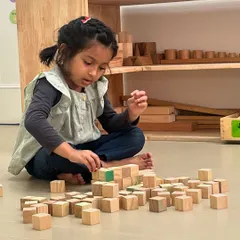
Building and Engineering Activities for Kids
 23
23
Creative LEGO Building Workshops
 7
7
Hands-On STEM & Science Fun for Kids
 63
63
Interactive Math & STEM Workshops
 10
10
Hands-on STEAM and Creative Workshops
More from Children's STEAM & Skill-Building Workshops by Build-It