The Art of Taal: Understanding Hindustani Rhythm
Taal is the heartbeat of Hindustani classical music. At Sangeet Sadhana, we approach rhythm as a language, guiding students from the basic mathematics of the taal system to the advanced nuances of layakari.
Continuing the lesson on rhythmic structures, Guru Shri Ashwin M P demonstrates Sultaal, a 10-matra taal. He plays it in 'ekgun' (single speed), 'dwigun' (double speed), 'tigun' (triple speed), and 'chaugun' (quadruple speed) to show how tempo variations are applied.
In the final part of this lesson, our Guru demonstrates Chautaal, a 12-matra taal. This video shows the practical application of the taal on the tabla, again progressing through 'ekgun', 'dwigun', 'tigun', and 'chaugun' layakari.
This is an educational guide to Teental, the most common 16-beat cycle in Hindustani classical music. Understanding its balanced structure of four 'vibhags' (sections) is essential for any student of tabla or vocal music.
We present an overview of Jhaptal, a 10-beat taal known for its unique 2-3-2-3 rhythmic division. Its asymmetrical structure makes it a dynamic and engaging cycle for both accompaniment and solo performance.
This infographic introduces Jat or Jot Taal, a 16-beat cycle used extensively for Thumri compositions. Its structure is particularly suited for expressive and emotive musical forms.
Here we illustrate the 'Ek Gunn' or single speed notation for Jat Taal. This shows the basic structure with one 'bol' per 'matra', establishing the foundational rhythm of the 16-beat cycle.
This chart shows the 'Du Gunn' or double speed notation for Jat Taal. Students learn to play two 'bols' per 'matra', a fundamental step in developing speed, clarity, and control in their tabla playing.
About The Art of Taal: Understanding Rhythm
At our Koramangala center, we teach tabla not by rote memorization, but by understanding the mathematics of time. Whether you are grappling with the balanced sixteen beats of Teental or the asymmetry of Jhaptal, Guru Ashwin ensures you develop 'layakari'—the ability to play with tempo—by connecting each 'bol' to its physical expression on the drum.
In the Hindustani shastriya sangeet tradition, rhythm is not merely a background pulse; it is a structural framework that allows for creative improvisation. Our curriculum focuses on the 'taal' system, where students progress from understanding simple cycles to executing complex improvisations across various speeds or 'layas'.
The Study of Layakari
We emphasize the concept of 'layakari', where a student learns to execute a rhythmic phrase in single (ekgun), double (dwigun), triple (tigun), and quadruple (chaugun) speeds. This is the cornerstone of developing speed, clarity, and precision on the tabla. As illustrated in our guides on Sultaal and Chautaal, consistent riyaaz is the only path to mastery.
Traditional Baithak Learning
Our offline batches in Koramangala are conducted in a traditional 'baithak' (floor seating) arrangement. This fosters an environment where the physical mechanics of playing—posture, hand positioning, and the use of the resonant 'bayan'—can be monitored closely by the Guru. This is an essential aspect of the Guru-Shishya parampara, ensuring that no technical nuance is lost in a large, impersonal classroom.
Theoretical Foundations
Beyond the physical practice, we teach the theory behind common cycles:
- Teental: The most ubiquitous 16-beat cycle, characterized by its balanced four-vibhag structure.
- Jhaptal: A 10-beat cycle with a distinct 2-3-2-3 division, offering a challenge in maintaining rhythmic stability.
- Jat/Jot Taal: Often used in thumri, this cycle is valued for its expressive potential in lighter, more emotive compositions.
Whether you are a beginner learning your first 'dha' and 'dhin' or an advanced student looking to refine your accompaniment skills, our small batch sizes ensure you receive the personalized attention required to deepen your musical sadhana.
Similar work from other experts
Browse through Curated picks from other experts on mytribe
Tabla and Mridangam Classes in Bengaluru
Learn Tabla: From Basics to Advanced
Tabla and Percussion Training in Delhi NCR
 4
4
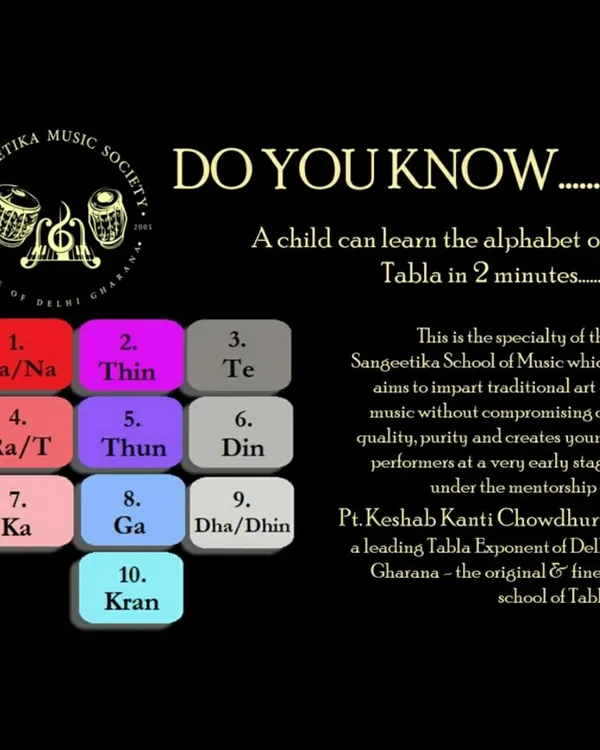
Learn Tabla Online with Authentic Delhi Gharana Training
 6
6
Music 101: Understanding the Basics
Your Tabla Learning Journey
More from Tabla Training by Sangeet Sadhana
More services by Sangeet Sadhana