Yoga with Props: Precision for Deeper Alignment
Props are not a crutch. They are tools that allow us to move beyond physical limitations and find the true expression of an asana. Whether you are a beginner using a strap or an advanced student working with Iyengar ropes, we focus on safe, steady alignment.
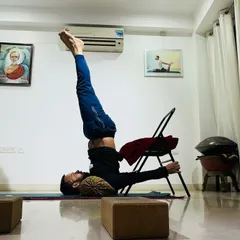
Here, students are using chairs and blocks for a supported shoulder and back opening exercise. This is a safe way for beginners to build flexibility for poses like Setu Bandhasana.
Using chairs to support Virabhadrasana I (Warrior I). This modification helps students focus on the upper body lift and backbend without straining the legs.
Students practicing Utthita Hasta Padangusthasana (Extended Hand-to-Big-Toe Pose) with the support of a chair. This helps maintain balance while working on hamstring flexibility.
Students using straps in Supta Padangusthasana (Reclining Hand-to-Big-Toe Pose). The strap allows for a gentle, controlled stretch of the hamstrings without straining the lower back.
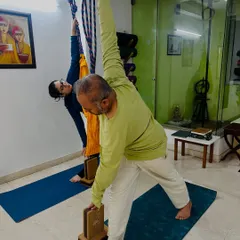
Blocks are used here to support the hands in Parsvottanasana (Pyramid Pose), allowing students with tighter hamstrings to maintain a long spine.
An advanced backbend, Dwi Pada Viparita Dandasana, practiced with the support of a chair. This allows for a deeper opening of the chest and shoulders.
Students using straps to assist in Eka Pada Rajakapotasana (Pigeon Pose). The strap helps to bridge the gap between the hand and foot, making the pose more accessible.
A partner-assisted stretch using a chair and bolster. This restorative pose allows for a deep release in the hips and spine with full support.
Using bolsters and blocks in a supported leg stretch. This restorative approach helps to release tension and increase flexibility passively.
Students practicing a supported leg extension on their backs. The block under the sacrum helps to stabilize the pelvis and deepen the stretch.
About Props for Deeper Practice
Beginners often think a strap is a sign of weakness, but in my shala, it is the opposite. When you use a strap to extend your reach in Supta Padangusthasana, you are actively engaging your muscles to maintain a straight spine and open your hamstrings. This precision prevents injury and builds the correct muscle memory required for more advanced flows later.
Many students enter the shala with tightness or limited mobility. They worry that needing a block or a chair means their practice is not serious. I tell them the truth: a prop is a tool for abhyasa, or consistent and dedicated practice.
Why We Use Props
Our goal is to align the body correctly so that energy can flow. If you round your back to touch your toes, you miss the point of the pose. A block under your hands allows you to keep your chest open and your spine long, even in Parsvottanasana.
How We Teach Alignment
In our group sessions in DLF Phase 5, you will see chairs used to support the pelvis in backbends or straps helping to guide the alignment in shoulder stands. For advanced students, we integrate Iyengar wall ropes to create traction, allowing for deep, safe openings in the chest and shoulders that would be impossible on the floor alone.
The Philosophy of Practice
Yoga is not about forcing the body into a shape. It is about understanding the mechanics of your own structure. Whether you are working on pelvic floor engagement or complex arm balances, these tools give your body the stability it needs to explore the full depth of an asana without pain. We are here to learn how to move with intelligence.
Similar work from other experts
Browse through Curated picks from other experts on mytribe
 22
22
Iyengar Yoga with Props: Precision and Alignment
Deepen Your Practice Safely with Props Yoga
Supported Yoga Alignment with Props in Delhi
Yoga with Props: Deepen Your Asana Practice in Koramangala
 16
16
The Art of Alignment: Using Props
Master Your Asanas with Prop-Based Yoga
More from Group Yoga Classes by Devender Bhardwaj
More services by Devender Bhardwaj