Navigating Divorce, Separation & Alimony
Divorce law shouldn't feel like a never-ending panga. I help you understand the realities of separation, alimony, and cruelty grounds without the confusing legal jargon.
Did you know you can't file for divorce within the first year of marriage? This is stated in Section 14 of the Hindu Marriage Act. But if living together is impossible, you are not stuck. I explain the option of Judicial Separation under Section 10, which allows you to live separately and file for divorce once the one-year period is over.
If your wife is constantly pressuring you to abandon your old parents, this can be considered mental cruelty. The Supreme Court has recognized this as a valid ground for divorce. In this video, I explain how you can file for divorce under Section 13 of the Hindu Marriage Act if you are facing such a situation.
A wife repeatedly threatening to commit suicide is a form of extreme mental cruelty. The High Court has confirmed that this is a valid ground for the husband to seek a divorce. If you are in such a distressing situation, know that the law provides a way out.
Intimacy is a crucial part of marriage. The Allahabad High Court recently passed a judgment stating that if a spouse denies sex to their partner for a long time without any valid reason, it amounts to mental cruelty. This can be a strong ground for filing a divorce petition.
After getting a divorce decree, when can you remarry? The waiting period depends on the law applied. Under the Family Courts Act, it's 30 days, while under the Civil Procedure Code, it's 90 days. I explain this timeline and the conditions to ensure your second marriage is legally valid.
If you got married in India but obtained a divorce in another country, is it valid here? Not automatically. I explain that if your marriage is registered in India, you need to get the foreign divorce decree validated by an Indian court. It's often simpler to file for divorce in India to avoid complications.
Judicial Separation under Section 10 of the Hindu Marriage Act is a legal remedy for couples who need time apart to rethink their relationship without ending the marriage. It gives you a chance to live separately while the law guides you, offering a path to either reconciliation or a future divorce.
About Navigating Divorce, Separation & Alimony
People often rush into filing for divorce without checking if they even meet the one-year legal requirement, which just complicates things later. Before we do anything, I look at whether your situation actually qualifies for Section 10 Judicial Separation. It is a strategic move that gives you space and protection while the law runs its course, rather than just jumping into a long-drawn courtroom fight that could have been avoided.
Divorce is heavy. You cannot just walk into court and file it the day after a fight. The law generally requires a one-year cooling-off period under Section 14 of the Hindu Marriage Act. If you are desperate for distance but cannot file for divorce yet, Judicial Separation is often the practical path. It lets you live separately without legally ending the marriage immediately.
The Cruelty Factor
Many clients come to me asking if their spouse's behavior counts as 'cruelty.' It is not just about physical violence. If your spouse constantly forces you to abandon your parents, threatens suicide, or denies intimacy without reason, the courts have recognized these as forms of mental cruelty. These are valid grounds to fight for your rights under Section 13.
Alimony Myths
Ignore the movie myths about fixed formulas. There is no standard calculator for alimony or property splits. The court looks at income, lifestyle, and your specific financial history. I help you gather the facts, not just the drama, to present a case that makes sense to the judge.
Why My Approach is Different
I do not believe in stringing clients along with false hope. Whether you are dealing with a contested petition, navigating child custody, or trying to understand if a foreign divorce is valid in India, I focus on what the law actually says, not what people assume it says. My goal is to get you the clarity you need to make decisions for your future, not to keep you trapped in a legal process longer than necessary.
Similar work from other experts
Browse through Curated picks from other experts on mytribe
Divorce and Separation: Legal Facts and Procedures
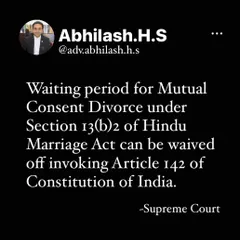

Understanding Mutual Consent and Contested Divorce
Divorce, Separation & Legal Rights in Delhi NCR
Grounds for Divorce & Annulment
Legal Guidance for Divorce, Separation & Annulment
Navigating Family & Marriage Laws in India
More from Family & Matrimonial Law by Arvind Maniam K
More services by Arvind Maniam K