Shoulder & Elbow: Restoring Full Range of Motion
Stop focusing only on the point of pain. I assess your entire shoulder complex to find the root cause, whether it is a desk-job posture, gym injury, or frozen shoulder, and use manual therapy to get you moving again.
This is post-arthroscopic surgery rehabilitation for a shoulder. In older patients with multiple issues like tendinosis, surgery is sometimes the best option. Here, on the very first day, we are starting with gentle active movements and ultrasound to manage inflammation.
Many patients wonder why I work on their back when their shoulder hurts. The shoulder is a complex of four joints, and the muscles that move it, like the rotator cuff, originate from the back. To fix shoulder pain, we must treat the entire system, not just the point of pain.
This is what my manual therapy for shoulder pain looks like. I'm performing a supraspinatus release, inferior glides, and scapulothoracic mobilizations. After every session, I reassess the patient's movement to track progress.
This patient was frustrated with physiotherapy that only used machines. He wanted a "crack" to fix his shoulder. I convinced him to try one session of my manual therapy, using Mulligan belts for glides. He was amazed by the results. Real physiotherapy is hands-on.
For frozen shoulder, once we gain some movement, we need to start overhead exercises. Here, I'm using a TheraBand on a ladder to assist the patient in lifting her arm. This modifies the exercise to her current ability and helps in scapular retraction.
This patient with shoulder pain has cupping marks all over his back. I'm performing manual release on his teres major and minor muscles. A combination of dry needling, manual therapy, and corrective exercises works wonders for gym-related shoulder injuries.
Can your sitting job cause shoulder pain? Absolutely. This patient developed rounded shoulders from his desk job, which led to tight pec and subscapularis muscles and restricted internal rotation. Posture is a major factor in many shoulder issues.
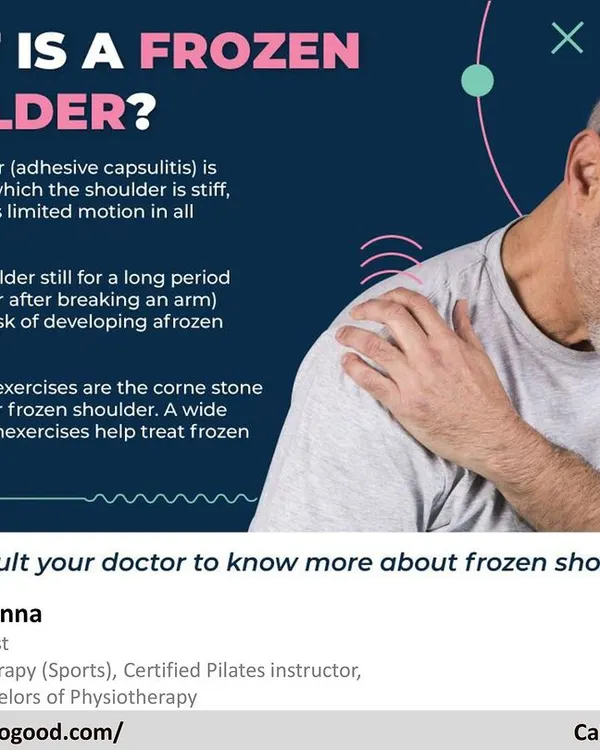
For this frozen shoulder case, I'm using dry needling on the front deltoid and pec muscles, which are often tight. The orientation of the needle matters. A 90-degree insertion releases trigger points, while a 45-degree angle stimulates the muscle.
This patient with frozen shoulder has better forward flexion but struggles with side abduction. This is common because the joint capsule tightens, restricting the humerus bone's movement. We have to be aggressive with mobilization to regain that range.
I don't use chiropractic adjustments on peripheral joints like the shoulder. I prefer mobilizations, which are essentially a graded form of the same principle. Here, a mobilization produced a "pop," showing that we can restore joint play without aggressive thrusts.
About Shoulder & Elbow: Restoring Full Range of Motion
Most shoulder pain isn't just about the shoulder joint. Often, your discomfort stems from a restricted scapulothoracic joint or tight pectoral muscles caused by long hours at a desk. When you visit my clinic, we don't just hook you up to a machine and hope for the best. I manually release specific tight tissues—like the teres major or subscapularis—and use targeted mobilizations to restore your joint play. You will feel the difference in your range of motion in the very first session.
If you have shoulder pain, you likely have a complex issue, not just a simple ache. The shoulder is a system of four joints, and when one part—like the scapula—is stuck, the rest of the system suffers. This is what we call the scapulohumeral rhythm. If your physio only treats the front of your shoulder, they are missing the bigger picture.
My Approach to Recovery
I don't believe in passive recovery. My sessions involve a rigorous assessment where I look at your posture, lifestyle, and movement patterns before I lay a hand on you.
- Manual Therapy: I use techniques like inferior glides, supraspinatus release, and mobilization with Mulligan belts. This is not about getting a 'crack.' It is about mechanically restoring the glide your joint has lost.
- Targeted Needling & Cupping: For deep muscle knots in the traps or deltoids, I use dry needling to stimulate release, often combined with cupping to improve blood flow in stiff areas.
- Active Rehabilitation: Manual therapy provides the relief, but your own movement is the medicine. I prescribe a progressive loading plan, moving from assisted range-of-motion exercises to strength training for your rotator cuff and rhomboids.
Why 'Quick Fixes' Fail
Many patients come to me in Najafgarh after being disappointed by clinics that rely solely on machines. You cannot fix a structural imbalance with a TENS unit. Whether you are dealing with a frozen shoulder, post-surgical stiffness, or gym-related impingement, the solution lies in restoring your range of motion and building the strength to support it. If you are ready to stop guessing and start healing, book an assessment.
Similar work from other experts
Browse through Curated picks from other experts on mytribe
Rehab, Mobility, and Movement Therapy
 10
10


Effective Shoulder, Arm, and Wrist Pain Relief
 5
5
Specialized Shoulder, Neck & Upper Body Rehabilitation
Expert Recovery for Upper Body & Spine Injuries
Mobility and Joint Recovery Training
Neck and Shoulder Rehabilitation
More from Orthopedic Physiotherapy & Pain Management by Shruti Raj
More services by Shruti Raj