Student and Co-Living Architecture Projects
We reimagine high-density student housing by treating circulation as social space. See how we balance limited site areas with human-centered design.
Our Stacked Student Housing project, completed in 2016, redefines density on a tight 111.5 Sq.m site. The form and fenestration are a direct product of the building's section, layering private living spaces efficiently.
The completed student housing building occupies a corner in a dense residential suburb, redefining its surroundings with its bold form and color.
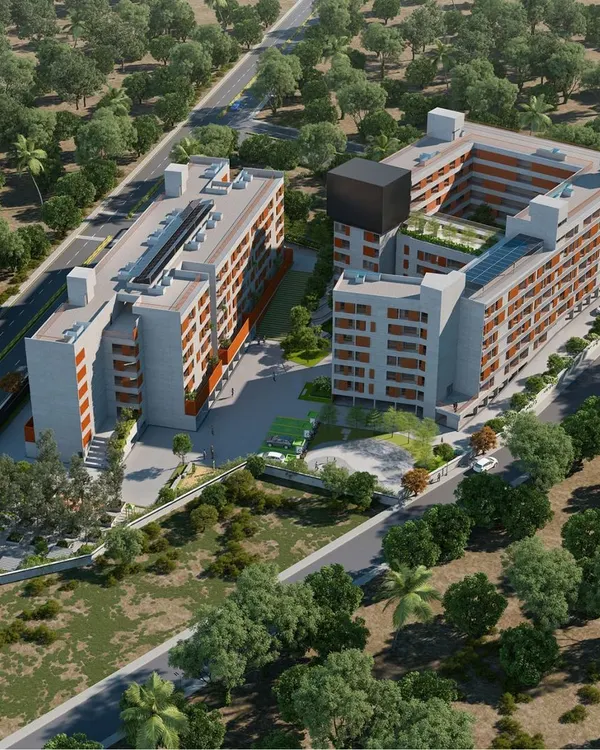
This render for our 'Coilspace' student hostel envisions a building where the facade is a living element. The design integrates extensive greenery, turning balconies and terraces into small gardens.
This axonometric drawing of 'Coilspace' shows how circulation space becomes social space. A continuous ramp allows inhabitants to cycle up to their rooms, transforming the corridor into an active, shared zone.
Ground breaking for the 'Coilspace' project in Bengaluru. This student co-living facility reimagines the speculative hostel as a ramped space to encourage new ways of using circulation and social areas.
This diagrammatic animation shows the form generation of 'Coilspace'. Starting with site margins, we arrange units, introduce stepped forms, and thicken corridors to create a dynamic social environment.
The building's monolithic red form makes a strong statement in its residential context, while the carefully placed windows maintain privacy for the inhabitants.
An elevated view showing the 'Stacked Student Housing' in its neighborhood context. The building's unique form is a result of its innovative sectional design.
The project demonstrates how a small site can accommodate high-density housing without sacrificing design quality or the privacy of its residents.
The pattern of fenestrations on the facade is not random but a carefully considered result of layering spaces for living within a compact volume.
About Student & Co-Living Spaces
In our student co-living designs, such as the Coilspace project in Bengaluru, we avoid the traditional double-loaded corridor. Instead, we use ramps that allow residents to walk or cycle to their rooms, effectively transforming simple circulation paths into shared social zones where interaction happens naturally, even in high-density conditions.
Designing for Density and Social Interaction
High-density living often forces a trade-off between privacy and interaction. Our approach to student housing and co-living facilities aims to resolve this by looking at the section of the building as the primary driver of form. In our 2016 Stacked Student Housing project, we utilized a compact 111.5 Sq.m site to prove that vertical density does not require compromising the quality of life.
The Thinking Hand in Co-Living
We do not rely on standard room-and-corridor typologies. By studying the daily rituals of students, we identify opportunities to introduce:
- Active Circulation: Converting hallways into wider, ramped spaces that function as informal meeting points.
- Volumetric Planning: Using site margins and building skins to ensure privacy while maximizing natural light.
- Adaptive Common Areas: Creating nooks and social hubs that prevent the feeling of isolation common in large hostel facilities.
Contextual Approach
Whether designing for an urban site in Bengaluru or a smaller town campus, our process begins with the site's unique growth patterns. We analyze wind paths, sun angles, and local socio-cultural dynamics before placing a single wall. For us, a successful student housing project is one where the architecture encourages the residents to step out of their rooms and engage with their environment. We invite you to look at our drawings and diagrams to understand the layered logic behind our student housing projects.
Similar work from other experts
Browse through Curated picks from other experts on mytribe
 37
37
Designing Architecture for Academic Communities
 7
7
Community Housing Design: Spaces That Build Interaction
 10
10

Innovative Housing and Co-Living Architecture
 10
10
Architecture for Community and Urban Living
 4
4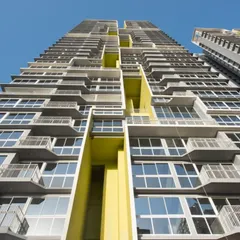
High-Rise Residential Communities
 13
13
Educational Architecture for Schools and University Campuses
More from Urban Design & Master Planning by Thirdspace
More services by Thirdspace