Student STEM Projects & Innovations in Mumbai
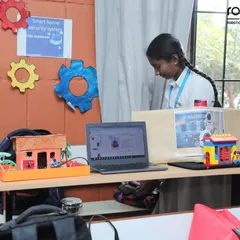
Watch our students move beyond textbooks. From coding Arduino traffic lights to demonstrating parallel circuits, here is how we turn abstract science concepts into real, working inventions.
A 10-year-old student demonstrates the traffic light he built using an Arduino. He explains the function of the microcontroller, digital pins, and jumper wires, showcasing a deep understanding of the project's electronics and code.
Here, a student presents two of his creations: an obstacle-avoiding robot that uses an IR sensor to detect objects, and a fan model with speed control. He clearly explains the components and logic behind each build.
This student demonstrates a parallel circuit he built. He explains how voltage is distributed differently than in a series circuit and proves it by removing one LED while the others stay lit, showing a solid grasp of electrical principles.
Watch as one of our students explains the fundamentals of a series circuit. He demonstrates how the circuit works and correctly identifies that if one component is removed, the entire circuit breaks, a key concept in electronics.
In this clip, a student explains the basic components of an LED circuit, including the breadboard, jumper wires, and slide switch. This end-of-session explanation helps reinforce what was learned and builds presentation skills.
Presenting at the VJTI Technovanza, one of our students explains his ambitious "Solar Sphere" project. He details how satellites could capture solar energy in space and transmit it to Earth, demonstrating advanced conceptual thinking and public speaking skills.
About Our Young Innovators in Action
At the end of every lab session, your child doesn't just pack up and leave. They spend the final minutes presenting their build to us, explaining the logic of their code, or why a circuit failed. We force this 'presentation moment' because knowing how to build is only half the battle; being able to articulate the 'why' and 'how' is what truly builds confidence and cements the learning.
Most tuition centers focus on getting the right answer for an exam. We do the opposite. When a student walks into our lab, they aren't just learning to pass a test; they are learning how to troubleshoot an obstacle-avoiding robot or explain why their series circuit failed.
Why the Presentation Matters
We see too many kids who can solve a problem on paper but freeze when asked to explain it. Our 'Young Innovators' process requires every student to verbally break down their project—whether it's an Arduino Nano setup, a solar power concept, or basic MS Office logic. This forces them to move from 'I memorized this' to 'I understand how this works.'
Real Skills vs. Rote Learning
- Circuit Mastery: We move from theory to reality. Kids stop drawing circuits and start wiring them on breadboards with jumper wires.
- Programming Logic: Whether it's Python or Scratch, the code has to make the machine move. If the robot doesn't avoid the obstacle, the code gets fixed until it does.
- Application: We take the concepts from your child's specific school syllabus (IGCSE, ICSE, or CBSE) and use them to build functional models.
We train students from Grade 1 to college, focusing on robotics, electronics, and coding. If you are looking for a place where your child will sit still and copy notes, this isn't it. If you want them to come home with a project that works—and the ability to tell you exactly how they built it—that is what we do.
Similar work from other experts
Browse through Curated picks from other experts on mytribe
Hands-On Robotics and Coding Projects
See Robotics and STEM Learning in Action
Robotics Projects and Creative Inventions
Our Young Innovators in Action
Student Robotics and Coding Projects in Gurugram
 5
5
Student Robotics Projects and Coding Innovations
More from Academic Tutoring (ICT & Science) by STEM Art Lab
More services by STEM Art Lab