Hands-On Robotics and Coding Projects
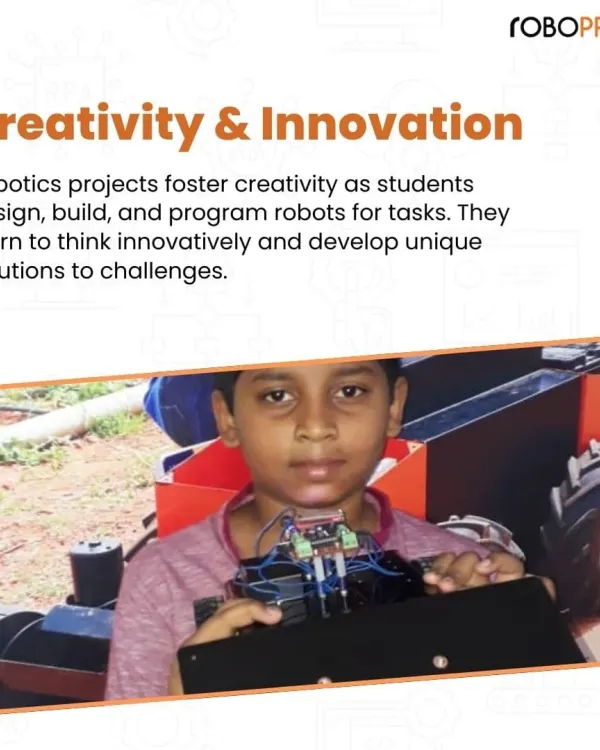
From sensor-based robots to custom mobile apps, see how our students turn complex STEM concepts into working reality through hands-on building.
For Independence Day, one of our young innovators created this automated flag-hoisting mechanism using LEGOs and a motor. It's a perfect blend of patriotism and technology.
Here's a step-by-step look at how to build an automatic streetlight using our DIY kit. The project uses an LDR sensor to detect darkness and turn on the lights, teaching a fundamental concept of automation.
Tired of water spills? This water level indicator, built by one of our students, uses a simple circuit to light up an LED when the water reaches a certain level. It's a fun and practical introduction to conductors and circuits.
We combine technology with tradition. Watch our 3D printer in action as it creates a detailed idol of Ganpati Bappa, demonstrating how 3D printing can bring any creative idea to life.
Another patriotic project, this line-follower robot proudly carries the Indian flag. Our students learn to program robots to follow a specific path using sensors, a core skill in robotics.
This is the first step in electronics: building a simple circuit on a breadboard to light up an LED using an Arduino Nano. We teach the fundamentals of microcontrollers and programming from the ground up.
Here's a creative solution for fitness tracking. One of our students developed an app that uses a phone's proximity sensor to automatically count push-ups. We encourage students to build apps that solve everyday problems.
This project demonstrates how to control the brightness of an LED using a potentiometer. It's a great hands-on way for students to understand variable resistance and circuit control.
A quick demonstration of building a simple circuit. We show how to connect a battery to a breadboard to power an LED, which is the foundational skill for all our electronics projects.
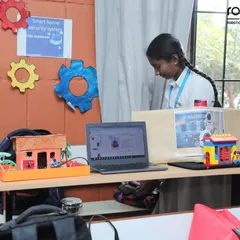
A colorful and imaginative amusement park built with LEGOs by our 'Tiny Tinkers' team for the FIRST LEGO League competition. The project uses gears and motors to create moving parts.
About Hands-On Project Showcase
Every project you see in this gallery, from the automated flag-hoister to the sensor-based push-up counter, is built by our students using real-world tools. We don't just stick to plastic building blocks; our students work with Arduino microcontrollers, laser-cut components, and Python code to solve real-world problems. This gives kids a genuine taste of engineering and logic before they even finish school, helping them move from simple mechanics to advanced IoT and robotics.
At Science Kidz, we believe that 'learning' shouldn't be about memorizing textbook definitions. It should be about getting your hands dirty. Whether it is building a simple LED circuit on a breadboard or programming an obstacle-avoiding robot, our approach ensures that every concept is backed by a physical build.
How We Build
Our project pathway is designed to scale with your child's age and curiosity:
- Fundamentals (Ages 5-9): We start with mechanical builds, gears, and block-based coding via Scratch. Here, the focus is on understanding cause-and-effect.
- Intermediate (Ages 10-13): Students transition to Arduino, learning the C++ syntax and basic electronics, including LDR sensors and motor drivers.
- Advanced (Ages 13+): This is where real-world applications come in. We move to Raspberry Pi, IoT, and text-based languages like Python and Java. Students fabricate custom parts using our 3D printers and soldering stations.
Why Project-Based Learning Works
When a student builds a water level indicator that actually works, they aren't just learning about conductors; they are learning how to debug, iterate, and solve problems. We have taken this approach from our centers in Kandivali and Andheri to schools across the Mumbai Metropolitan Area. Innovation doesn't need a fancy address; it just needs a student who is willing to try, fail, and try again. If you want your child to stop just consuming technology and start creating it, come visit us for a trial session.
Similar work from other experts
Browse through Curated picks from other experts on mytribe
Robotics Projects and Creative Inventions
Inside the Lab: Hands-On Robotics & Building Process
Our Young Innovators in Action
Student Inventions: From Code to Creation
 14
14
Student Robotics Projects: From Idea to Working Robot
 5
5
Student Robotics Projects and Coding Innovations
More from Kids' STEM & Tech Programs by Science Kidz
More services by Science Kidz