Science and Nature: Experiential Learning for Children
Science is not just a subject in a textbook. It is about getting hands dirty at a sanctuary, observing life cycles, and asking questions until children truly understand the world around them.
Direct interaction with animals fosters empathy and respect for life. During our field trip to Prani, The Pet Sanctuary, children had the opportunity to feed a horse, learning about its diet and gentle nature firsthand.
A child bravely reaches out to feed an emu. These real-world experiences are incredibly powerful, moving learning from the pages of a book into a memorable, multi-sensory event.
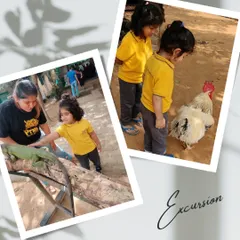
A student gently touches an iguana under the careful supervision of a guide at the sanctuary. This hands-on encounter helps demystify reptiles and sparks scientific curiosity about different animal species.
After interacting with the animals, students take time to draw and write in their journals. This crucial step helps them process their observations, solidify their learning, and practice scientific documentation.
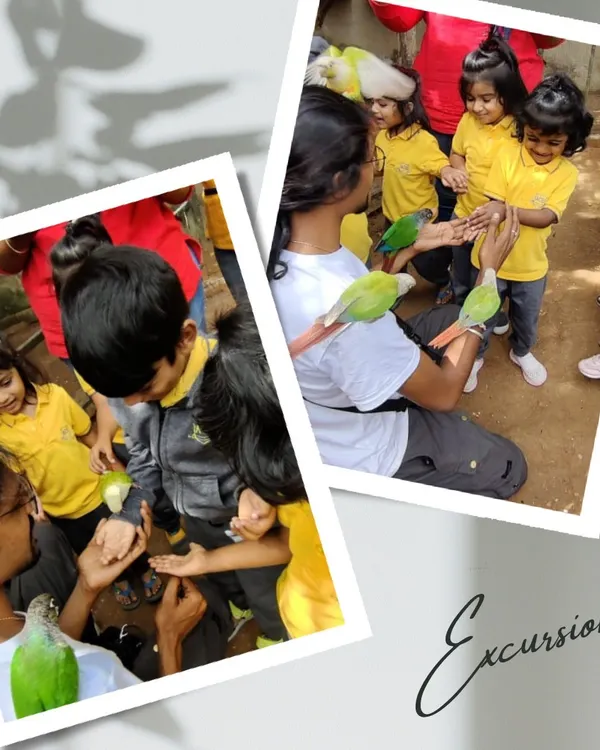
A group of children gathers to gently hold a small animal. Shared experiences like this build community and create lasting memories, all while learning about animal care and biology.
The excitement is visible as our elementary students line up for their field trip. Outdoor education and real-world exploration are a vital part of my elementary program, extending learning far beyond the classroom.
The journey is part of the adventure. Children travel together on the bus to the pet sanctuary, building social skills and anticipation for the day of learning ahead.
A child carefully holds a hamster, learning how to be gentle and respectful with a small, delicate creature. This teaches responsibility and empathy.
After a morning of exploration at the sanctuary, the children gather for a community lunch. Field trips are holistic experiences that also build social skills and independence.
Our students arriving at the sanctuary, ready for a day of experiential learning. I believe in taking education outside, where children can see, touch, and feel what they are studying.
About Exploring Our World: Science & Nature
Science comes alive when children move from reading about animals to actually observing them in their habitat. During our trips to sanctuaries like Prani, I see kids shift from passive listeners to active scientists—taking notes, documenting their observations, and learning the vital lesson of empathy alongside biology. It is messy, exciting, and the best way to make sense of the world.
In the Montessori method, science is not taught in isolation. We move beyond diagrams to real experiences that connect biology with our daily lives. When we visit a pet sanctuary, children are not just interacting with animals. They are learning about dietary needs, habitats, and responsible care. This is where scientific curiosity takes root.
We place a heavy emphasis on observation and documentation. After a hands-on encounter—whether it is feeding a horse or holding a hamster—students return to their journals. Writing and drawing what they witnessed helps them process the complex sensory information. It is this practice of scientific documentation that builds a bridge between the physical experience and abstract understanding.
Our approach fosters empathy alongside academic rigor. By treating nature with respect, children learn that they are stewards of their environment. Whether we are studying the life cycle of a plant in the classroom or observing animal behavior in the field, the goal remains the same: to keep the child’s natural curiosity alive and turn it into a lifelong habit of inquiry.
Similar work from other experts
Browse through Curated picks from other experts on mytribe
 44
44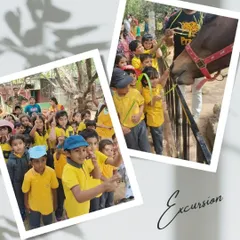
Science & Field Trips: Learning By Doing
Hands-On Science and Nature Discovery for Kids
 89
89
Little Scientists: Hands-On Nature Experiments
Field Trips & Nature Learning: Learning Beyond the Classroom
 89
89
Nature-Based Learning & Field Trips for Preschoolers
 20
20
Exploring the World Around Us through Hands-On Discovery
More from Montessori Elementary School Program (Ages 6+) by Siksha Montessori
More services by Siksha Montessori