Hair Transplant Myths and Facts Explained
Before you decide on a hair transplant, get the facts right. Understand the science of hair restoration, the importance of donor zone management, and what truly makes a procedure successful.
There is a lot of misinformation about hair transplants. This post introduces some of the most common myths I hear from patients, which I will address with factual information to help you understand the procedure better.
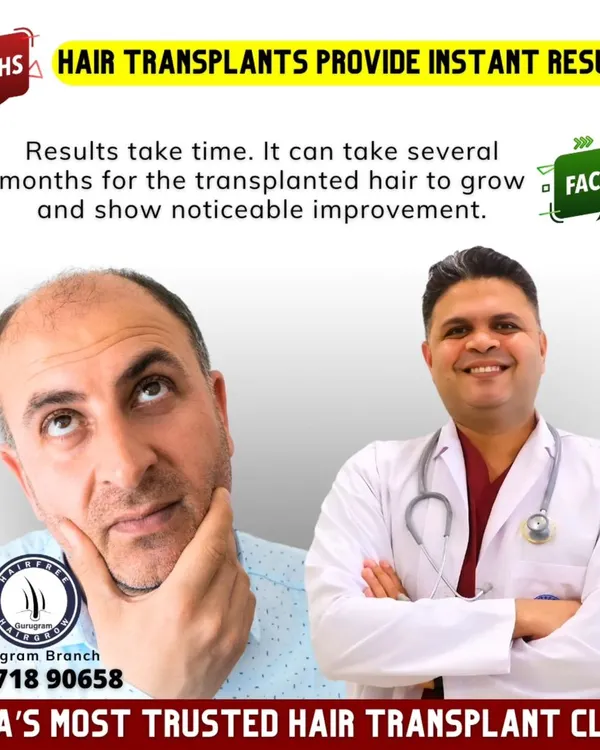
Myth: Hair transplants give instant results. Truth: This is a journey of growth. Real, visible hair growth typically begins around 3 to 4 months after the procedure, with the full, mature results becoming apparent after 9 to 12 months.
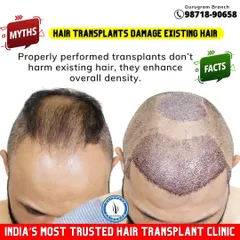
Myth: All transplanted hair stays forever. Truth: The follicles I transplant from the permanent donor zone are permanent. However, the surrounding native hair can continue to thin over time, which is why a long-term medical management plan is often necessary.
Myth: One hair transplant is enough for everyone. Truth: This depends entirely on the individual. The extent of your hair loss, the quality of your donor area, and your desired density will determine if multiple sessions are needed over time.
This image shows a surgeon at work, highlighting the precision required. I use this to introduce a series of common questions and myths about the hair transplant procedure.
Myth: Hair transplants are painful. Truth: The procedure is performed under local anesthesia, which numbs the scalp completely. Patients may feel some pressure or movement, but the process is designed to be comfortable with minimal pain.
Myth: Hair transplants look unnatural. Truth: In the past, techniques could result in a "pluggy" look. However, with modern FUE and FUT techniques and artistic hairline design, I create results that are indistinguishable from natural hair growth.
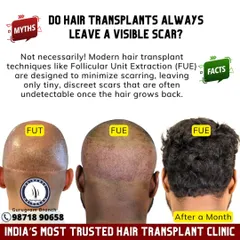
Myth: All hair transplants leave visible scars. Truth: Advanced techniques are designed to minimize scarring. With FUE, there are tiny, dot-like scars that are virtually invisible. With FUT, I use a special trichophytic closure so hair can grow through the fine linear scar, concealing it effectively.
Myth: Hair transplants are expensive. Truth: While there is an initial investment, the results are permanent. When you compare it to the ongoing cost of temporary solutions like hair systems or medications over a lifetime, a transplant is often the most cost-effective solution.
Preparing for your surgery is a key step for ensuring safety and a smooth procedure. This guide outlines the essential precautions I advise all my patients to take, including necessary blood tests, avoiding certain medications, and arranging post-op transport.
About Patient Education: Understanding Hair Transplants
Many patients ask me if the hair will fall out again after a few years. Here is the science: I only transplant hair from your permanent donor zone, which is the hair at the back of your head designed by nature to last a lifetime. If a surgeon takes hair from outside this zone, it will likely shed within a few years. Understanding this difference is the single most important step to avoiding a failed procedure and ensuring your results stand the test of time.
Understanding the Journey
A hair transplant is not a one-day event. It is a biological process. When you leave my clinic, the work has just begun. Real hair growth typically becomes visible around 3 to 4 months, and you will see the final, mature results after 9 to 12 months. Being patient during this growth cycle is part of the treatment.
Why Corrective Surgery is Common
I see many patients who come to me after a procedure elsewhere resulted in a pluggy, unnatural hairline. This usually happens when the surgeon treats the hairline like a straight line rather than a soft, irregular transition. I use the 'stick and place' method and create a zigzag pattern to ensure that when your hair grows, no one can tell you have had a transplant.
Donor Area Preservation
Your donor area is a finite resource. Once those follicles are gone, they are gone forever. My protocol focuses on 'Safe Zone' harvesting. This means I never over-deplete your donor area. If we need more grafts for a large scalp reconstruction, I utilize body hair (beard or chest hair) to supplement the count rather than ruining the back of your head.
The Trichophytic Difference
If you have had a previous FUT (strip) surgery that left a visible linear scar, I perform a Trichophytic closure. This is a specialized stitching technique that allows hair to grow directly through the scar, effectively camouflaging it. It is a detail that takes more time, but it makes a massive difference in how natural your head looks when your hair is cut short.
Similar work from other experts
Browse through Curated picks from other experts on mytribe
Hair Transplant Facts & Myth-Busting
Hair Transplant Questions Answered by a Dermatologist
 10
10
Hair Transplant Myths vs. Facts
 10
10

Hair Restoration Guide: Expert Advice for Informed Decisions
 10
10
Busting Common Hair Transplant Myths
Your Hair Transplant Questions, Answered
More from Corrective Hair Transplant by Vikas Panthri
More services by Vikas Panthri