Ceiling Fans: Choosing the Right Airflow & Efficiency
Don't just pick a fan by how it looks. Get the right size, height, and star rating for your room to ensure you actually feel the air.
A simple tip that can save you over a thousand rupees a year on your electricity bill. I explain the difference between a 1-star and a 5-star rated fan and tell you which one is right for your bedroom versus your drawing room.
Bigger is not always better. Putting a large fan in a small room or a small fan in a large room will result in poor airflow. I explain how to choose the right fan size, from 24 inches for a kitchen to 48 or 56 inches for bedrooms and living rooms.
If your fan is not providing good air, the reason might be its height. For optimal air delivery, a fan's blades should be at least 12 to 14 inches below the ceiling. Using a short rod, especially with a false ceiling, is a common mistake that I advise against.
About Ceiling Fans: A Guide to Airflow & Efficiency
Most fans fail to deliver because of simple installation mistakes, not the brand. If your fan blades are too close to the ceiling or the sweep size is wrong for your room dimensions, you will never get the airflow you paid for. I always check the room size first because a 1200mm fan in a large hall or a short rod on a false ceiling kills the air before it even reaches you.
When you buy a ceiling fan, stop looking at the price tag and start looking at your room dimensions. A fan is a long-term investment in comfort, and getting the basics right saves you money on electricity bills for years.
The BLDC Difference
If you run your fan for 18 to 24 hours a day, do not buy a standard fan. Shift to BLDC (Brushless DC) technology. While a standard fan consumes 50 to 55 watts, a 5-star BLDC fan runs on 26 to 32 watts. Over a year, this saves you thousands of rupees, essentially making the fan free within a few seasons. Always check the star rating; it is mandatory, and it is your biggest tool for energy efficiency.
Size Matters
There is a common myth that a bigger fan is always better. It is not. If your room is roughly 10x10 or 10x12 feet, a 1200mm (48-inch) fan is perfect. If your room is larger, only then upgrade to a 1400mm (56-inch) fan. If you put a large fan in a tiny room, you will not get proper air circulation. For smaller spaces like bathrooms or kitchens, a 600mm (24-inch) fan is all you need.
The Height Rule
This is where most installations go wrong. Because of false ceilings, people often use very short rods. For optimal air delivery, the fan blades must be 12 to 14 inches below the ceiling. If you mount it too close, the fan cannot pull air effectively, and you will end up blaming the fan brand when the installation was the problem. Stick to the company-provided rod lengths; they are designed for a reason.
Similar work from other experts
Browse through Curated picks from other experts on mytribe
 8
8
Designer Ceiling Fans for Modern Homes
Chandelier Fans: Modern Ceiling Lighting with Fans
Designer & Remote-Controlled Fans for Modern Homes

Lighting, Fixtures & Interior Finishes
 11
11

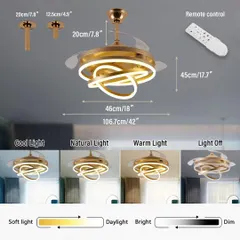
Modern Fandeliers: Stylish Fan and Chandelier Hybrids
 8
8


Smart Climate & Appliance Automation
More from Core Electricals & Safety Systems by Amit Agarwal
More services by Amit Agarwal