Journey into Space: Astronomy and Rocketry for Kids
We don't just teach space science with charts. We help your child build the rockets, code the satellites, and navigate the constellations through hands-on engineering.
A student builds a "swamp boat" designed to detect dangers like alligators and rocks using a color sensor. I guide him to think about the real-world application, collecting data over time and plotting it on a bar graph.
Astronomy is a gateway to science, integrating math, physics, and chemistry. Through activities like stargazing and model-building, we make learning about the universe a captivating and hands-on adventure.
We explore the magnificent Orion constellation, known as the Hunter in Greek mythology. It's a cosmic masterpiece in our night sky and a great starting point for learning about stars, nebulae, and the myths written in the sky.
A supernova is a star dying in full glory. This graphic, featuring an image from NASA's James Webb Space Telescope, explains how these cosmic explosions forge vital elements and shape galaxies.
The Taurus constellation, the celestial bull, is an iconic part of the night sky. We learn to spot its V-shaped horns and the dazzling red giant star, Aldebaran, while exploring the myths behind it.
This project is a future satellite navigator. Students learn to build and code a robot to navigate to a launch site and activate communications, peeking into the future of space exploration and the importance of precision.
We celebrate India's giant leaps in space, like the Gaganyaan mission. We also discuss Vyommitra, the female robot that will travel to space to mimic human activities, inspiring the next generation of space scientists.
The Auriga constellation, the charioteer, graces our winter skies. Its pentagon shape and brilliant stars have captivated stargazers for centuries, and we learn the rich mythology behind it.
Where did it all begin? We explore the universe's first act: the formation of the Hydrogen atom. This simple element is the building block of stars and the fuel for the rockets that take us on our cosmic adventures.
Meet Canis Minor, the "little dog" in the night sky. This constellation features Procyon, one of the brightest stars, and its story is tied to the great hunter Orion, making it a fun celestial character to find.
About Journey into Space: Astronomy & Rocketry
You won't find just textbook charts here. In this module, your child isn't simply memorizing constellations; they are coding a 'swamp boat' prototype to detect hazards and mapping that data onto real bar graphs. They are building a satellite navigator using LEGO bricks and coding the pathing logic to launch it, making the transition from theory to real-world engineering feel less like a lesson and more like a mission.
Our approach to space science is rooted in the idea that kids learn best when they treat the universe as a playground. We don't lecture; we ask questions. When we discuss a supernova, we look at the physics of stellar fusion. When we study the Orion constellation, we explore the mythology behind it while learning how to spot stars in the night sky.
Hands-On Space Engineering
We use a mix of LEGO SPIKE kits, Python, and block-based coding to bring these concepts to life.
- Rocketry & Navigation: Students don't just talk about space travel. They build prototypes of satellite navigators, program motor rotations for rocket launches, and simulate the precision needed for a successful mission.
- Data & Logic: We integrate math and physics into every project. A student building a hazard-detection boat isn't just playing with sensors; they are writing code to create counter variables, learning to collect data, and plotting it on graphs to determine which hazards appear most often.
- The 'Genius Labs' Vibe: Our lab is designed for trial and error. Things break. Code doesn't compile on the first try. That is exactly the point. By debugging their own projects, students develop the grit needed to solve complex problems.
Whether your child is fascinated by the Gaganyaan mission, curious about the composition of Mars, or wants to understand the 'little dog' in the night sky, we provide the tools to turn that curiosity into technical skill. We keep our batches small, typically 1:4 or 1:5, so every 'inventor' gets the mentorship they need to see their project through from initial design to final launch.
Similar work from other experts
Browse through Curated picks from other experts on mytribe
 22
22
Hands-On Science & STEM Workshops for Kids
Inside the World of ISRO & Space Exploration
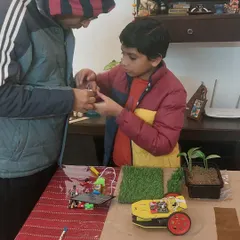
Hands-On STEM Workshops & Science Projects
Robotics Projects and STEM Builds for Kids in Delhi
 8
8
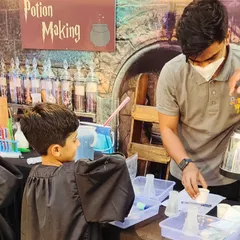
Hands-on STEM Workshops & Science Parties
Hands-on Science & STEM Projects
More from STEM Workshops & Camps by GeniusLabs
More services by GeniusLabs