Build Robotic Cars and Line Followers in Delhi
Why just play with toy cars when you can build, code, and drive them? At our Pitampura lab, we help kids turn raw gears and sensors into smart machines that navigate, race, and think on their own.
Yashvi shows the power of iteration by converting her obstacle-avoiding robot into a table-following bot. This project highlights how a single creation can be adapted and improved with new logic.
Ivaan's multi-color line follower bot uses a color sensor to detect and navigate a track with different colors. This advanced project teaches complex sensor calibration and conditional logic.
Advit's obstacle avoider bot in action. Using an ultrasonic sensor, it intelligently detects and maneuvers around hurdles, demonstrating the core of autonomous navigation.
A showcase of various student-built cars. From simple remote-controlled models to more complex sensor-based bots, each vehicle is a canvas for creativity and engineering.
My students preparing their black line follower robot for the Technoxian competition. They work together to fine-tune the sensors and code for maximum speed and precision on the track.
Ivaan built a unique remote control for his car using four touch sensors for forward, backward, left, and right movements. This project was a creative exploration of alternative user interfaces.
A compilation of wheeled creations, including trikes and line-following robots. These projects are fundamental in teaching kids about motors, chassis design, and remote control systems.
A student tests her line-following robot on a spiral track. This exercise challenges the bot's sensors and motor control to handle continuous curves.
Ivaan's table follower bot uses an ultrasonic sensor to maintain a consistent distance from the table's edge. It's a great project for understanding proportional control and sensor feedback.
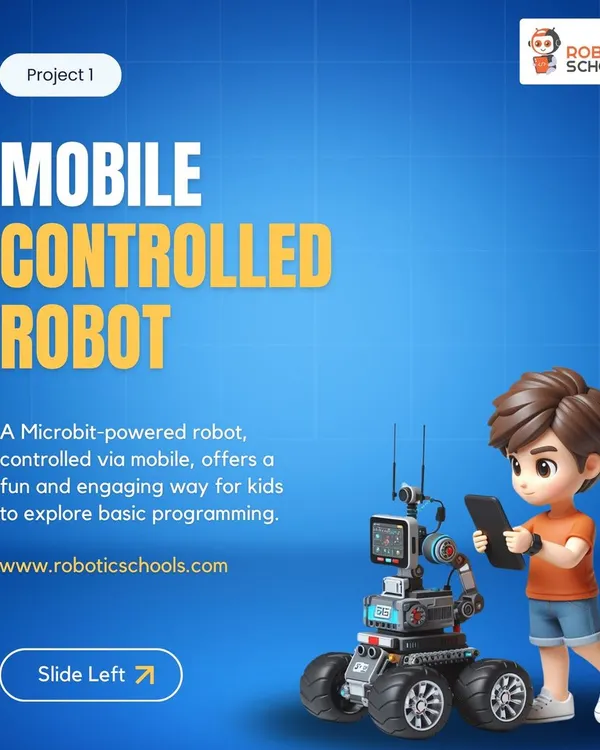
A close-up of a Bluetooth-controlled car built with an Arduino UNO. Students learn to integrate a Bluetooth module and use a smartphone app to control their creation wirelessly.
About Wheels, Tracks & Remote Controls
Your child won't just follow a manual here. Whether it is a remote-controlled car or a line-following bot, they start with a chassis, motors, and code, debugging every motor stall themselves. We use real industrial-grade sensors and Arduino boards so the moment those wheels finally turn, the achievement belongs entirely to them.
Engineering Real Motion
We don't believe in plastic kits that snap together. In our workshop, kids use real tools. We teach them how to mount DC motors, calibrate IR sensors for line detection, and write the logic that tells a robot when to turn. This is how they learn to distinguish between a loose connection and a code error.
The Learning Journey
Every project in this cluster is designed to teach a specific engineering principle:
- Remote-Controlled Cars: Understanding motor drivers, power distribution, and Bluetooth connectivity.
- Line-Followers: Mastering PID logic and IR sensor calibration to handle sharp curves and different track surfaces.
- Obstacle Avoiders: Integrating ultrasonic sensors to make autonomous decisions.
We keep our batches small, with only 4 to 8 students per cohort. This ensures that when a car doesn't move, we don't just fix it for them. We sit with them to diagnose why the code is stalling or why the motor torque is insufficient. We run our programs out of our Pitampura center, serving young makers from across Delhi NCR who want to swap passive screen time for active, mechanical problem-solving.
Similar work from other experts
Browse through Curated picks from other experts on mytribe
Build Your Own Remote Controlled Robot
Student Showcase: Robotic Cars & Vehicles
 6
6
Robotics Project Blueprints for Kids
Build Your Own Robots and Gadgets
Robotics and STEM Workshops for Kids in Noida
Advanced Robotics and Coding Programs for Kids
More from STEM Camps & Competition Training by Be A Robonaut
More services by Be A Robonaut