Yoga with Props for Alignment and Accessible Asanas
Props are not crutches, they are keys that unlock your potential. We use blocks, chairs, and wall ropes to help you understand your body and explore poses safely.
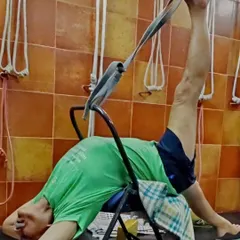
This video provides a step-by-step tutorial on how to use a yoga chair for a full backbend. I explain how to safely enter and exit the pose, making this advanced posture accessible and allowing for a supported, deep release of the spine.
Here, I demonstrate how to use a chair to practice Shalabhasana (Locust Pose). The chair provides support for the torso, allowing you to focus on strengthening the back muscles and lifting the legs, which is excellent for improving posture.
A yoga strap is a versatile tool for deepening stretches. In this video, I show how a strap can be used in Bhekasana (Frog Pose) against a wall to intensify the quadriceps stretch while keeping the body in a stable, relaxed position.
This is another demonstration of using a strap and the wall to work on back and leg flexibility. Props allow you to hold poses longer, giving your muscles and connective tissues time to release safely.
Using a strap in Poorna Bhujangasana (Full Cobra Pose) helps to draw the shoulders back and lift the chest. This modification assists in achieving the full expression of the pose while protecting the lower back.
Wooden blocks are essential for bringing the floor closer to you. Here, they are used in Urdhva Dhanurasana (Wheel Pose) to elevate the hands, making the pose more accessible for those with tight shoulders or wrists.
A chair can also be used to build strength for poses like Mayurasana (Peacock Pose). This video shows how to use the chair as a stable base to practice lifting the legs, developing the core and arm strength required for the full asana.
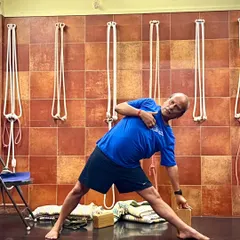
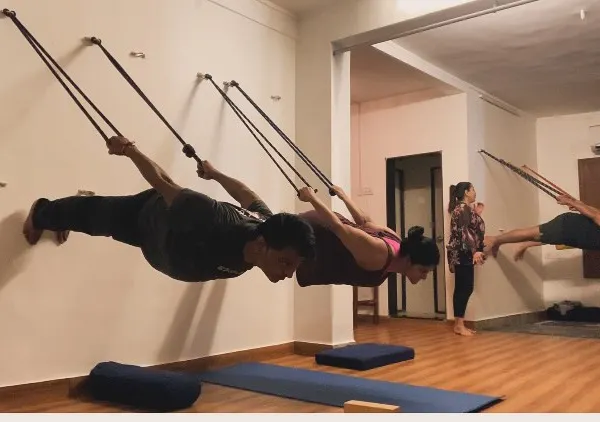
Our group practices often involve the yoga wall. Here, students use the wall ropes and blocks for support in Ardha Chandrasana (Half Moon Pose), helping them find stability and perfect their alignment in this challenging balance.
The yoga wall is fantastic for supported inversions. Hanging upside down, as seen here, helps to decompress the spine, improve circulation, and bring a sense of calm, all without any pressure on the neck or head.
A student demonstrates the use of the yoga wall ropes to achieve Samakonasana (Center Splits). The ropes provide support to suspend the body, allowing gravity to help deepen the hip-opening stretch in a controlled manner.
About Yoga with Props: Making Asanas Accessible
At our Koramangala shala, we don't just use props to make poses easier; we use them to help you learn the mechanics of your own body. Whether it is a chair to support a backbend or wall ropes for spinal traction, these tools allow you to safely explore postures that might otherwise feel out of reach, ensuring you build strength without straining your joints.
Why We Use Props
Many practitioners treat props as optional additions, but in our lineage, they are essential teachers. They guide you toward the correct alignment, allowing you to hold poses longer and reap the deeper benefits without risking injury.
Our Key Tools:
- Yoga Wall & Ropes: We use these for restorative work and spinal health. Hanging upside down in a supported inversion is one of the most effective ways to decompress your spine after a long day at a desk.
- Chairs: From assisting backbends to building core strength for arm balances like Mayurasana, the chair provides a stable base that lets you safely test your limits.
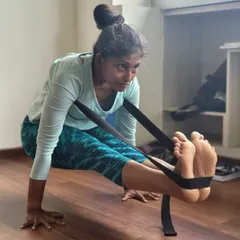
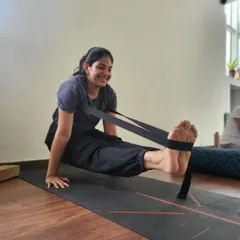
- Blocks & Straps: These bridge the gap between your current flexibility and the full expression of an asana. They help you lengthen your spine in forward bends and open your chest, preventing you from collapsing into a pose before you are ready.
Who is this for?
If you are recovering from an injury, working with chronic stiffness, or simply looking to refine your technique, this approach is for you. We provide hands-on, manual adjustments to ensure you are not just performing a pose, but feeling it correctly. We welcome everyone—from absolute beginners stepping onto the mat for the first time to experienced practitioners looking to break through a physical plateau in our advanced workshops. Practice is everything, and with the right support, you will find your own rhythm.
Similar work from other experts
Browse through Curated picks from other experts on mytribe
The Iyengar Method: Using Props for Precision
Yoga with Props: Accessible Practice for Every Body
Iyengar Inspired Yoga Classes with Props in Janakpuri
 11
11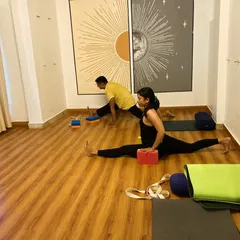
Props & Alignment: Safe Yoga for Every Body
The Art of Alignment: Precision Yoga with Props
Yoga with Props: Precision for Deeper Alignment
More from Group & Private Yoga Classes by Nirakula Yoga
More services by Nirakula Yoga