Legal Defense for Family & Criminal Disputes
When family disagreements cross into legal trouble, the stakes rise quickly. I help you navigate these sensitive cases, from domestic violence to cyber harassment, ensuring your rights are protected without unnecessary court appearances.
In domestic violence cases, it's crucial to understand your rights. For instance, the Supreme Court has clarified that a husband's personal presence is not always mandatory in these quasi-criminal proceedings. I ensure that due process is followed and your rights are protected at every stage.
There is a significant legal difference between a 'breach of promise' and a 'false promise to marry'. If consent for a relationship was obtained through deceit with no intention of marriage, it can have serious legal consequences under Section 69 of the BNS. I can help you understand the nuances of your situation.
If you are a victim of cyber harassment involving morphed or obscene photos, the law is on your side. I can help you file for an injunction to compel social media platforms like Instagram to remove the content and disclose the identity of the anonymous perpetrators.
Understanding when a serious criminal case can be quashed is complex. I explain the difference between compoundable and non-compoundable offenses and the inherent power of the High Court to quash a case based on factors like unequivocal consent and the case's impact on society.
Lying under oath, or perjury, is a serious offense under Section 193. However, the Supreme Court has clarified that simply denying an allegation in an affidavit does not automatically amount to perjury. Proceedings are only initiated in exceptional circumstances involving deliberate falsehood on a substantive matter.
About When Family Law Meets Criminal Law
When a family dispute turns criminal, the biggest fear is often immediate police involvement or the requirement to attend court hearings constantly. It is important to know that in many domestic violence or quasi-criminal proceedings, your personal presence is not always mandatory. We can often file specific applications to exempt your appearance, allowing you to manage your work and personal life while we handle the legal filings and arguments. Let's look at the specific facts of your case to see if this exemption is a viable strategy for you.
Handling the Intersection of Family and Criminal Law
Family law often overlaps with criminal law, especially in cases of domestic violence, cruelty allegations, or harassment. This 'quasi-criminal' territory is where most people get overwhelmed. My approach is to demystify these proceedings and focus on procedural protection.
Why Personal Appearance Isn't Always Required
In cases like domestic violence, trial courts or the High Court might insist on your presence. However, I often rely on Supreme Court observations clarifying that personal appearance is not mandatory for every hearing in quasi-criminal matters. We can file an application to exempt you from appearing, saving you significant time and stress.
Protection Against Cyber Harassment
If you are facing cyber harassment, such as the circulation of morphed or obscene images, you do not have to wait for the police to act. Courts can pass strong injunction orders directing social media platforms like Instagram or Meta to remove content and disclose user information, such as IP addresses. Acting quickly with a court-ordered injunction is often the most effective way to stop the damage.
Navigating False Allegations
Concepts like 'breach of promise' versus 'false promise to marry' are often misunderstood. Under the new legal frameworks like the BNS, distinguishing between a change of heart and intentional deceit is critical. A false promise made with no intention of marriage is a serious matter, but a genuine breach due to circumstances is not criminal. I help you break down the legal nuances of your specific situation to build a strong defense or negotiation strategy.
The Path to Quashing
If you are dealing with a non-compoundable criminal case that arose from a family dispute, there are avenues to resolve it. Based on Supreme Court rulings, even serious charges can be quashed if parties have reached an amicable settlement, provided it serves the interest of justice. I guide you through the process of invoking the High Court's inherent power to seek relief.
Similar work from other experts
Browse through Curated picks from other experts on mytribe
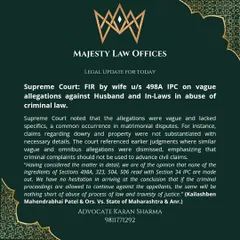
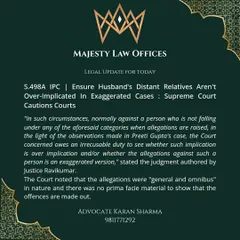
Defending Against False Matrimonial Allegations
 9
9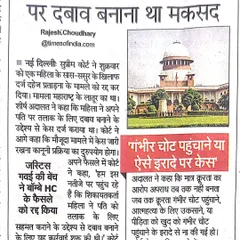
Legal Defense for False 498A and Matrimonial Cases
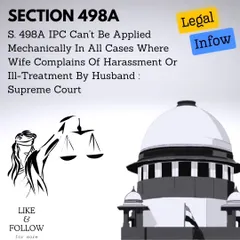
Navigating 498A and Domestic Violence Cases
Defending Against False Matrimonial Allegations
 9
9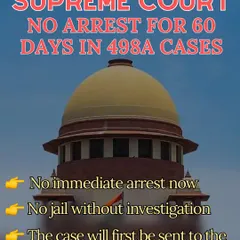

Legal Protection from Domestic Violence and False 498A Cases
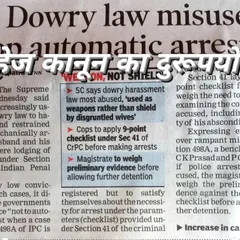
Matrimonial Legal Defense and 498A Support
More from Family Law by Abhishek Tiwari
More services by Abhishek Tiwari