Patchy Hair Loss Treatment for Alopecia Areata
Sudden, round bald spots are often caused by alopecia areata, an autoimmune response where your immune system targets hair follicles. My treatment focuses on calming this reaction and stimulating new growth with targeted medical interventions.
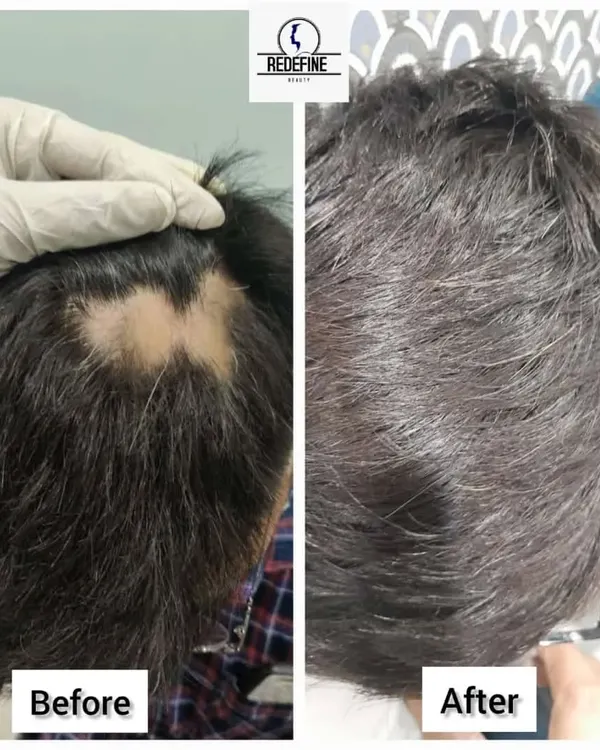
This before and after comparison shows the successful outcome of our treatment for Alopecia Areata. The patient's patchy hair loss was resolved, leading to full and healthy hair coverage across the scalp.
This educational video explains what Alopecia Areata is and demonstrates the treatment process. You can see a close-up of the intralesional steroid injection, a targeted therapy I use to help patients achieve hair regrowth.
About Treating Patchy Hair Loss (Alopecia Areata)
Many patients worry that injections for hair loss will be painful, but I use ultra-fine insulin syringes combined with vibration distraction to make the procedure comfortable. We typically treat up to three coin-sized patches in one sitting, delivering medication directly into the skin to calm the inflammation and encourage your hair follicles to start producing again.
Understanding the Patchy Hair Loss Process
Alopecia areata happens when your immune system mistakenly attacks healthy hair follicles. It is not just about losing hair, it is about managing an autoimmune response. When you come to my clinic in Paschim Vihar, we do not jump to procedures. We start with a 20-minute diagnostic session using digital dermoscopy to analyze your follicles and determine the exact stage of hair loss.
The Treatment Approach
For active patchy hair loss, my primary method is intralesional steroid injections. I inject Triamcinolone Acetonide directly into the dermis. This suppresses the local immune reaction that causes the patch and creates a healing environment for new hair to sprout.
Why Medical Accuracy Matters
- No Guesswork: We use digital dermoscopy to view miniaturization levels before deciding on treatment.
- Controlled Delivery: We use low-concentration steroids (2.5mg to 5mg/ml) to prevent skin atrophy or depression at the site.
- Recovery: There is no downtime. You can resume your daily routine immediately after the session.
Common Questions
- Does the hair grow back permanently? In many cases, yes, once the inflammation is controlled and the autoimmune trigger is managed.
- Is it painful? We use vibration distraction and ultra-fine needles to keep it comfortable.
- How many sessions are needed? This depends on the number of patches and how your body responds, which we monitor closely at every follow-up.
Similar work from other experts
Browse through Curated picks from other experts on mytribe
 7
7
Alopecia and Patchy Hair Loss Treatments in Greater Noida
Treating Special Hair and Scalp Conditions in Delhi
 4
4
Advanced Hair Loss Treatments and Transplants in Delhi
 4
4
Understanding Hair Loss: Causes, Diagnosis & Real Solutions
Identifying the Root Causes of Your Hair Loss
Understanding Your Hair Loss: Diagnostic Medical Care
More from Hair Restoration & Loss Treatment by Munish Paul