Advanced Robotics & IoT Student Projects
Explore functional robots and IoT devices built by our students. From autonomous cars to smart waste systems, this is hands-on engineering in action.
This team of 8th graders built a solar-powered cleaning robot. They explain how solar panels charge the battery, which powers both the DC motor for movement and a water pump for cleaning, creating a sustainable and autonomous solution.
Our students present a solar-powered obstacle-avoiding car. They detail its practical applications, from a movable surveillance system to a tool for dangerous situations like floods or fires, showcasing their understanding of both engineering and real-world problem solving.
Powered by the sun and controlled by a remote, this solar car is a fantastic example of integrating sustainable energy with robotics. Our 8th-grade students demonstrate how they engineered the car to be controlled using a custom button box, showing their grasp of both hardware and user interface.
Watch as our students explain the inner workings of their Bluetooth-controlled car. They break down how an HC-05 Bluetooth module communicates with an Arduino board and motor driver to translate commands from a smartphone app into the car's movements.
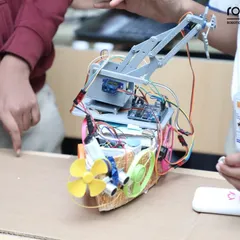
Here, our 7th-grade students demonstrate a "pick and place" robotic arm. They show how they use potentiometers to control servo motors, allowing for precise movements to grab and move objects. This project is a great introduction to industrial automation concepts.
We are so proud of Poonkuzhali from Grade 5, who built this amazing robot by herself after being inspired in our classes. She creatively used logic gates for the light-up eyes and mouth and repurposed two remote cars for balance, showing how foundational knowledge sparks independent creation.
This light-following car, built by our 8th-grade students, uses two LDR sensors to detect the brightest light source. The students explain how the Arduino board processes the sensor readings to steer the car, demonstrating a clear understanding of sensor-based logic and control.
Watch our Grade 5 student, Samriddhi, confidently explain her obstacle-avoiding car. She details every component, from the Arduino board to the ultrasonic sensor, demonstrating a deep understanding of the mechanics and programming. This is hands-on learning in action.
A student from our program clearly explains her DPDT car experiment. She identifies each component, including the double pole double throw switch, DC motors, and wheels, before giving a successful demonstration of how it works.
Kiara from Class 5F shows off her DPDT car project. She demonstrates how the double pole double throw switch controls the direction of the car, showcasing her understanding of basic mechanical and electrical principles through this hands-on build.
About Student Projects: Advanced Robotics & IoT
It is one thing to learn coding syntax in a classroom, but it is a different experience when that code makes a robot navigate an obstacle course in real time. We focus on that moment where students transition from theoretical circuits to functional, programmable hardware. Our projects ensure that when a student builds an autonomous car or an IoT device, they are not just following a guide, but troubleshooting their own logic until the machine works as intended.
Our Advanced Robotics & IoT curriculum is designed for students in grades 5-10 who are ready to move beyond basic mechanics. We use the Arduino Uno R3 platform to bridge the gap between simple circuitry and complex automation.
What Students Build
- Autonomous Vehicles: Projects like obstacle-avoiding cars and light-following bots that utilize IR and LDR sensors to make real-time decisions.
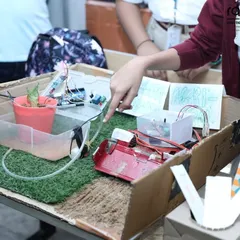
- Smart IoT Systems: Practical applications such as smart dustbins and automated plant watering systems that teach the integration of hardware and software.
- Communication Modules: Using HC-05 Bluetooth modules, students learn how to interface hardware with smartphone apps for remote control functionality.
The Learning Process
We avoid heavy theoretical lectures. Instead, we bring all necessary custom kits—microcontrollers, sensors, and actuators—directly to the school. The process is centered on learning by doing. Students gain proficiency in C++ programming and hardware debugging while working in teams to solve tangible problems. Whether it is calibrating ultrasonic sensors to measure distance or programming motor drivers for movement, every step is designed to build confidence and prepare them for future engineering challenges.
Similar work from other experts
Browse through Curated picks from other experts on mytribe
 14
14
Student Robotics Projects: From Idea to Working Robot
Student Robotics Projects: From Code to Creation
Student Robotics Projects and Engineering Demonstrations
Robotics Projects and STEM Builds for Kids in Delhi
Hands-On Robotics and Coding Projects
Our Young Innovators in Action
More from STEM Programs for Schools by Robomations
More services by Robomations