Electronics & Coding Fundamentals for Grades 1-4
Watch how our students turn simple breadboards and motors into working inventions. These are their first steps into the world of tech.
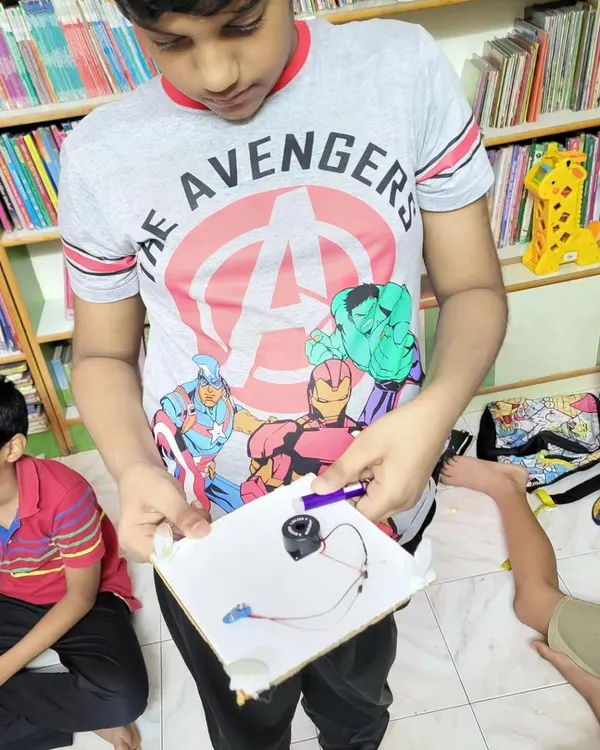
Two of our young students collaborate on an experiment with an SPST switch and a DC motor. The student explains how the switch completes the circuit to convert electrical energy into mechanical energy, demonstrating a core concept of electronics.
"Red, you need to stop. Yellow, you need to get ready. Green, you need to go." These students recreated a traffic light using LEDs, resistors, and jumper wires. This project helps them learn about basic circuits and sequencing in a fun, relatable way.
This group of students explains their slide switch circuit, which controls two different LEDs. They correctly identify it as an SPDT (single pole double throw) switch and discuss its use in common devices like torches and toys.
This team of fourth-graders proudly presents their clap-activated ON/OFF system. They explain how a sound sensor detects a clap to trigger the circuit, turning a light bulb on and off. It's a fun introduction to sensor technology.
Two students present their IR-based visitor counter project. They explain how it uses an infrared sensor and a microcontroller to count people or cars passing by, demonstrating its practical use in public places like toll gates.
These students showcase their IR-based automatic hand washer and dryer. They demonstrate how placing a hand near the sensor activates a water pump or a fan, a great project for understanding hygiene-related technology.
Even our youngest innovators get hands-on experience. Here, Arhaa from Grade 1 confidently demonstrates an LDR (Light Dependent Resistor) circuit, showing how the light turns on and off by controlling the light source.
Shreya demonstrates an ultrasonic sensor circuit she built. She explains that the sensor's purpose is to measure the distance of an object and correctly identifies all the components used, including the Arduino board and jumper wires.
This team of students demonstrates their "10 Running Lights" project. They show how turning a trimmer's knob controls the speed and number of LEDs that light up in sequence, learning about variable resistance and visual feedback.
Ronen, Graceia, and Anirudh from Grade 3 present their six-LED forward and reverse running light model. They identify the components on the PCB, including transistors and an IC, and explain its decorative applications in malls and homes.
About Student Projects: Electronics & Coding Fundamentals
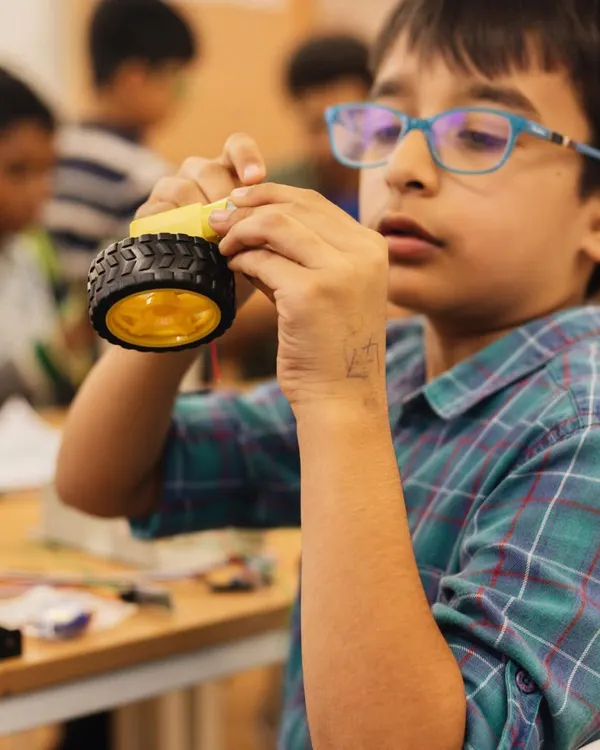
In this module, we move beyond theory to get kids working with tangible hardware. Instead of just talking about circuits, your child will use actual breadboards, DPDT switches, and DC motors to build their own gadgets. They learn why a connection fails—or succeeds—by doing it themselves, turning frustration into that specific moment when their project finally lights up or starts moving.
Building the foundation for future innovation happens when students stop watching and start doing. Our electronics and coding fundamentals program for grades 1-4 is designed to demystify technology.
Hands-on Learning
We don't rely on boring lectures. We bring the lab to the classroom. Using custom kits with real components like sensors, LEDs, and resistors, students build projects they can touch and control. Whether it is an IR-based hand washer or a clap-activated switch, every project is built by the student.
Key Concepts
- Circuitry Basics: Understanding open and closed loops, series, and parallel connections.
- Component Familiarity: Learning what resistors, transistors, and sensors actually do.
- Logic & Sequencing: Applying basic coding concepts to control physical movement and light patterns.
- Problem Solving: Debugging a circuit when the LED doesn't light up is often the most valuable part of the process.
Why This Matters
At this age, the goal is confidence. When a 3rd grader explains how a potentiometer controls light flow, they aren't just reciting facts—they are internalizing how things work. By the end of our 8-10 week module, students leave with more than a certificate; they leave with the knowledge that they can build, break, and fix technology on their own terms. We operate in schools across Bengaluru, bringing all necessary materials so you just need to bring your curiosity.
Similar work from other experts
Browse through Curated picks from other experts on mytribe
 8
8Hands-on Robotics and Coding Curriculum
Electronics & Coding Fundamentals for Young Makers
Hands-on Robotics Programs for Schools
 10
10
Electronics & Robotics Projects for Kids
Young Engineers: Hands-on Robotics and Coding Classes
 33
33
Robotics & STEM Enrichment: Hands-on Engineering for Kids
More from STEM Programs for Schools by Robomations
More services by Robomations