Math is Everywhere: Making Concepts Click
Math isn't just about formulas in a textbook; it's the hidden logic behind everything around us. See how we connect numbers to nature, games, and daily life.
Can a cube, a cylinder, and a cone all hold the same amount of water? This experiment on volume shows that looks can be deceiving and helps students understand concepts visually, not just through formulas.
How far could you see from the top of the Burj Khalifa? We use fun questions like this to explain real-world physics and geometry, showing how a simple formula can help us understand the curve of the Earth.
Ever wondered why car wheels are round and not square? We explore the geometry of shapes to explain why a circle is the most efficient shape for rolling, connecting a simple observation to a core mathematical principle.
The formula for a circle's circumference, 2πr, isn't just a rule to memorize. We prove it with a simple cup and string, giving students a tangible way to see how math formulas work in the real world.
Meet the 'Algebra Plant', a real plant from West Africa whose leaves grow according to an algebraic formula. This is a perfect example of how math is embedded in nature itself.
The reason your iPhone is so perfect is thanks to an Indian statistician. We explain the Mahalanobis distance, a quality control concept used to ensure every product meets the right standards.
What makes a face beautiful? The answer lies in the golden ratio. We explore how this mathematical principle, approximately 1.618, appears in art, architecture, and even human faces.
On Navy Day, we explore how ancient sailors measured a ship's speed in 'knots'. They used a simple formula (speed = distance/time) with a knotted rope and an hourglass, a clever application of math at sea.
Did you know your favorite songs can help you learn math? We show how musical notes can be used to teach fractions and ratios, turning artists like Taylor Swift into fun, unconventional math teachers.
You can use a simple math formula to check how healthy you are. We explain how to calculate your Body Mass Index (BMI) and what the numbers mean, connecting math directly to personal health and wellness.
About Math is Everywhere
Instead of teaching formulas first, we start with a question or a physical object. If we are explaining circumference, we don't just write 2πr on the board; we take a cup, a string, and a ruler to prove why the formula works. When kids see the logic in action, they stop memorizing blindly and start predicting the math behind the world they see every day.
Why teach from a book when the world is a giant math lab? At Bhanzu, we turn every observation into an opportunity to learn. Our 'Math is Everywhere' modules are designed to bridge the gap between abstract classroom theory and real life.
We break down complex topics using things kids already know. Pizza slices aren't just snacks; they are the perfect way to understand fractions. Musical beats explain ratios, and the geometry of a car wheel explains why circles roll smoothly. By grounding abstract concepts in reality, we help students build cognitive skills that stick.
It is not just about getting the right answer; it is about how you get there. Our students learn to see patterns in everything, from the coastline paradox to the golden ratio in nature. This fosters a natural curiosity and helps them develop the mental math speed we are known for, without feeling like they are grinding through homework. It is math made fun, logical, and applicable.
Similar work from other experts
Browse through Curated picks from other experts on mytribe
 15
15
Fun with English & Math: Engaging Learning for Kids
 10
10

Fun Brain Boosters: Turning Math Challenges into Play
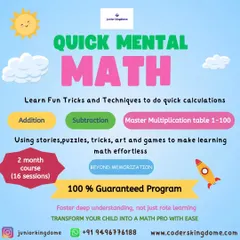
Mastering Math: Fun and Fast Learning
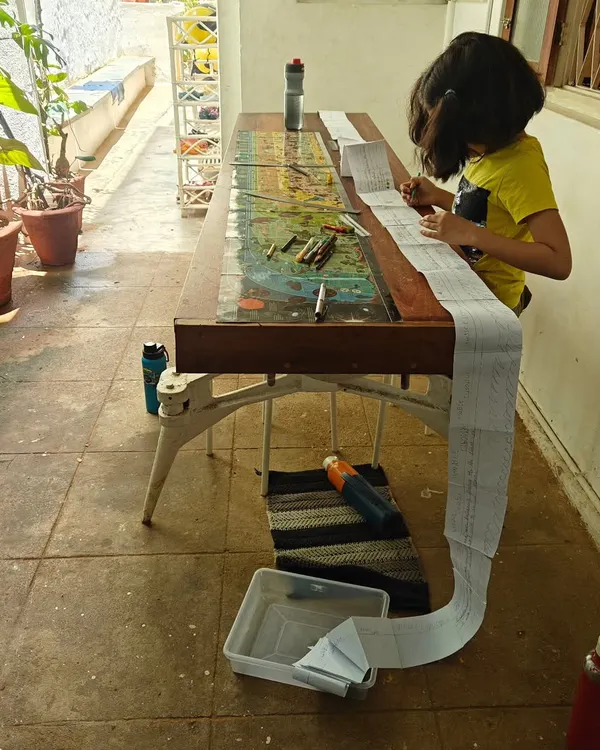 20
20

Learning Mathematics Through Discovery and Wonder
 16
16
Making Math Magical: Creative Math Enrichment for Kids
 13
13


Making Learning Fun and Relatable for Kids
More from Online Math Classes for Kids (K-9) by Bhanzu