Fun Math Facts and Mind-Blowing Numbers
Math is not just about solving problems for an exam. It is hidden in the patterns of nature, the rhythm of music, and the logic of our favorite movies. Let us change how you see numbers.
We all know Aryabhata, but did you know he wrote a second book on astronomy that was lost to time? Or that he was the one to scientifically explain eclipses, debunking the myths of Rahu and Ketu?
The Fibonacci series was actually discovered by an Indian poet, Acharya Pingala, 1500 years before Fibonacci. He found the pattern, which he called 'Matrameru', while analyzing the rhythms of Vedic poetry.
Shakuntala Devi, the 'Human Computer', was more than a math prodigy. She was also an astrologer and wrote several books, including one on homosexuality, which was groundbreaking for its time.
P.C. Mahalanobis is known as the 'Father of Statistics' in India. He was a member of the first Planning Commission of independent India and founded the Indian Statistical Institute in Kolkata.
Many consider Carl Friedrich Gauss the 'Prince of Mathematicians'. His work on the prime number theorem, the orbit of the asteroid Ceres, and the Gaussian distribution are fundamental to modern math and statistics.
The great mathematician Srinivasa Ramanujan actually failed his college exams because he struggled with non-math subjects. His genius was so focused on numbers that he found 17 different ways to write pi as an infinite series.
At just 23 years old, Aryabhata wrote his famous book 'Aryabhatiya'. He was also one of the first to propose that planets move in elliptical orbits and correctly calculated the Earth's circumference.
November 23rd is Fibonacci Day. We celebrate the Italian mathematician who discovered the famous sequence (1, 1, 2, 3, 5, 8...) that appears everywhere in nature, from sunflowers to seashells.
Here's a strange math fact: the square root of 0.98 is approximately 0.98. Math can be weird and wonderful.
If you multiply 111,111,111 by itself, you get a perfect palindrome: 12,345,678,987,654,321. Palindrome numbers read the same forwards and backwards, like a mathematical mirror.
About Did You Know? Fun Math Facts
We believe math should be as interesting as a story, not a chore. Instead of memorizing formulas, our students learn through concepts and patterns that stick for a lifetime. If your child sees numbers as a hurdle, we are here to show them the fun, logic-driven path forward.
The facts you see here are just the tip of the iceberg. At Bhanzu, we look at the history of math, from Aryabhata to Ramanujan, to show kids that they are part of a long tradition of thinkers. We do not teach tricks or rote memorization. Our online programs use a teacher-student ratio of 1:6, ensuring every child gets the attention they need to grasp concepts rather than just learning steps.
Whether your child is 5 or 14, our curriculum is designed to replace fear with confidence. We connect arithmetic to real-world applications, helping students understand the logic behind the numbers. If you are tired of the old way of learning, our sessions offer a fresh start. We focus on building cognitive skills through games, puzzles, and interactive modules. This approach helps kids finish tasks faster and develop a genuine interest in problem-solving that goes beyond the classroom.
Similar work from other experts
Browse through Curated picks from other experts on mytribe
 15
15

Fun with English & Math: Engaging Learning for Kids
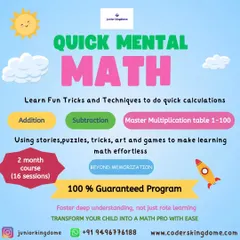
Mastering Math: Fun and Fast Learning
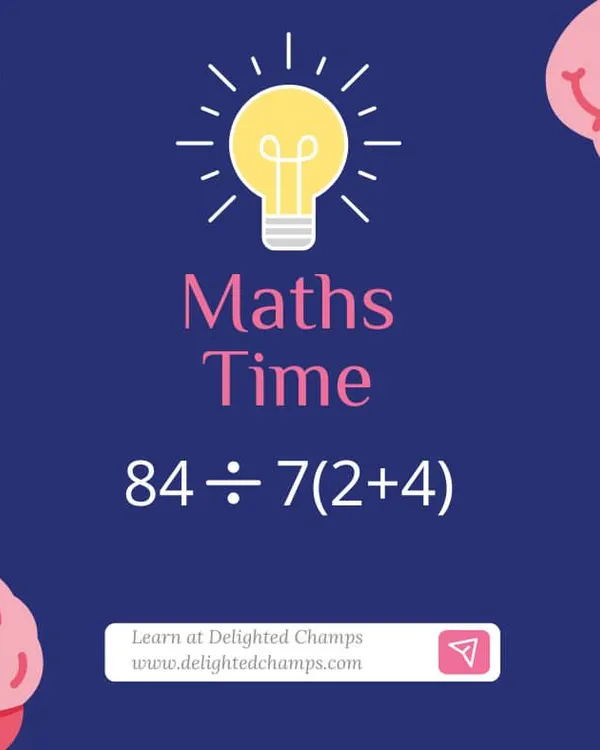 10
10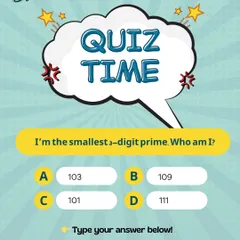

Fun Brain Boosters: Turning Math Challenges into Play
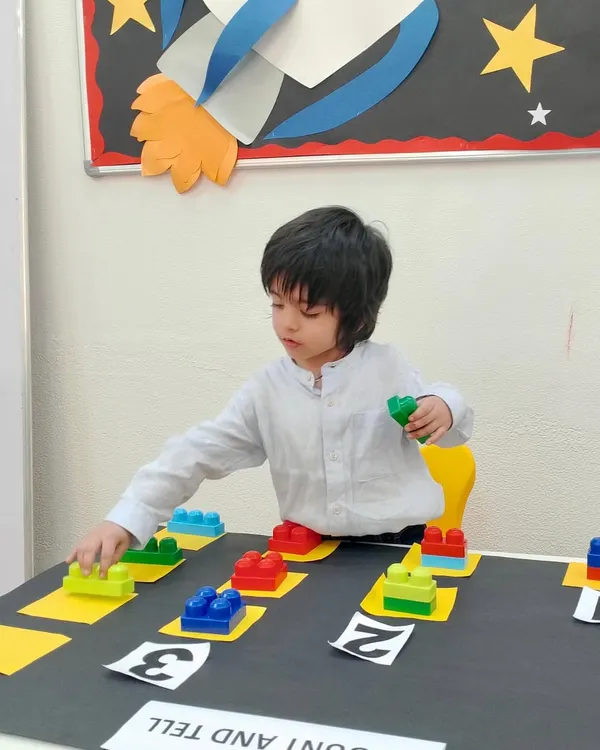 16
16
Making Math Magical: Creative Math Enrichment for Kids
Vedic Maths Magic: Lightning-Fast Calculation Skills
Advanced Mental Math for Kids
More from Online Math Classes for Kids (K-9) by Bhanzu