Practical Legal Help for Money Recovery and Financial Disputes
Financial disputes can be overwhelming, but you have rights. From recovering outstanding payments to navigating cheque bounce notices, I simplify the legal process to help you take the right steps.
If someone owes you money and isn't paying it back, you have legal options. I explain the two step process for money recovery, starting with a legal notice and moving to a civil suit if necessary, and why you should avoid cash transactions.
Wondering what to do if a cheque you received bounces? The law has a very specific and time sensitive process. I break down the crucial 30, 15, and 30 day rule for filing a cheque bounce case to ensure you can recover your money.
Before you agree to be a guarantor or surety for someone's loan, you must understand the risks. I explain how Section 128 of the Indian Contract Act makes you equally liable for the debt, a mistake that can have serious financial consequences.
It's a difficult situation when a relationship ends, and you've lent money or given expensive gifts. I explain the legal realities of recovering money lent versus gifts given, and the importance of having proof for a successful recovery suit.
About Money & Financial Disputes
The most important factor in any financial dispute is evidence. If you lent money via cash, proving it in court is an uphill battle. My process focuses on realistic assessments—I will tell you upfront if your proof, such as bank transfers or written agreements, is strong enough to hold up in a civil suit, saving you the expense of pursuing a case that lacks the necessary foundation.
Navigating Financial Disputes
Financial law often feels like a maze, but it is bound by strict procedural rules. Whether you are dealing with an unpaid debt, a bounced cheque, or risky surety liabilities, understanding these rules is your first line of defense.
The Cheque Bounce (Section 138) Timeline
If a cheque has bounced, timing is everything. The law provides a very narrow window for action. You must adhere to the 30-15-30 day rule:
- 30 Days: You have 30 days from the date of the cheque return memo to issue a legal notice.
- 15 Days: The defaulter has 15 days from the receipt of notice to make the payment.
- 30 Days: If payment is not made, you have 30 days to file a criminal complaint before the Magistrate Court. Missing these deadlines can result in your case being dismissed, regardless of the merits.
Money Recovery Suits
For non-cheque debt recovery, we typically initiate with a formal legal notice. This is a crucial step to establish that you have formally demanded the money. If the notice is ignored, we move to a civil suit for recovery. I prioritize evaluating your evidence—bank statements, emails, or written contracts—before we proceed to ensure we are filing a case with a high probability of success.
The Surety Trap
One of the most dangerous positions you can take is acting as a surety for someone else's loan. Under Section 128 of the Indian Contract Act, your liability is co-extensive with the principal borrower. This means banks can pursue you for the full amount if the borrower defaults. Before you sign any document, I help you evaluate the risks, as the financial consequences can be severe.
Similar work from other experts
Browse through Curated picks from other experts on mytribe
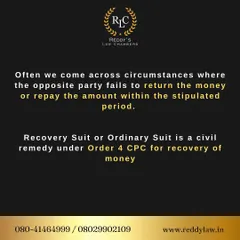
Money Recovery and Financial Dispute Legal Services
Legal Solutions for Financial Disputes & Money Recovery
 4
4


Financial Dispute Resolution Services in Delhi NCR
 4
4


Commercial and Business Law Services
 6
6


Complex Civil & Financial Litigation
Banking & Finance Law Explained
More from Civil & Commercial Litigation by Abhilash H.S
More services by Abhilash H.S