Student Robotics Projects: From Idea to Invention
See how our students turn theory into reality. From autonomous rescue bots to custom-coded games, these projects are built by kids and teens using our Maker Lab kits.
Watch Harish demonstrate the Bluetooth-controlled car he built. He showcases how it can be controlled via a smartphone using both joystick commands and gesture controls, and explains the full circuit involving an Arduino, motor driver, and Bluetooth module.
Vivaan presents his 'Medicine Delivery Robot', a project with real-world applications. He demonstrates its ability to carry items, use a grabber claw, and navigate autonomously, showing a thoughtful approach to solving practical problems with robotics.
Here, Jaden explains his line-follower robot, a foundational project in automation. He details the components used, including IR sensors and an Arduino Uno, and demonstrates how it can be used in factory settings for transporting loads along a designated path.
Nandhan presents his autonomous robot, which combines two key functions: line following and object detection. He explains the use of multiple IR sensors and an ultrasonic sensor to create a smart robot that can navigate its environment independently.
Combining a passion for cricket with technology, Gowrish created this 'Cricket Playing Bot' for a project challenge. He explains how he used two beginner kits to build a ball thrower and a hitting mechanism, demonstrating creativity and resourcefulness.
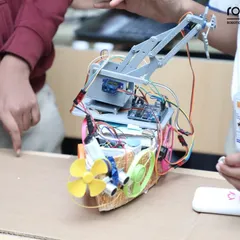
Sanjay showcases his 'Fire Rescue Robot', a project designed to help in hazardous situations. He explains how the robot can navigate difficult areas and use its arm to assist, demonstrating a practical application of our beginner-level Ranger robotics course.
Ashwath presents his 'Robotic Path Finder', designed for exploration in dangerous terrains. He demonstrates how the robot follows a path and uses a connected camera for live video feedback, even sharing his future plans to integrate it with satellite technology.
See how our student Ayaansh built a functional burglar alarm in his first level of robotics. He clearly explains how the IR sensor detects motion, triggering a buzzer and LED to alert people, demonstrating a core concept in electronics and sensor technology.
Dharan explains his radar project built with a Micro:bit, ultrasonic sensor, and servo. He demonstrates how it detects objects, measures distance, and provides an alert, giving a clear, step-by-step overview of both the hardware connections and the code.
Here, Shanmukh demonstrates his ultrasonic sensor-based radar system. He explains its potential uses in security and obstacle avoidance and shows how it detects objects within a specific range, triggering a buzzer as an alert.
About Student Project Showcase: From Idea to Invention
Every robot, app, or alarm system you see here was designed, wired, and coded by our students. They use real hardware—like Arduino boards, IR sensors, and ultrasonic modules—to solve actual problems, such as automated medicine delivery or home security. We guide the logic, but the building and troubleshooting happen entirely at their own fingertips.
How We Build Future Innovators
At SP Robotic Works, we follow the philosophy of 'padichu pogaadhey, sei pannu!' (Don’t just read, do it!). We believe that true learning happens when a child hits a snag, stops, and figures out how to fix their own code or circuit.
The Learning Path Our projects are structured by age and skill level to ensure no child feels overwhelmed:
- Junior (7+): We start with Scratch block-based coding and modular kits. Projects like the 'Robot Truck' or 'Burglar Alarm' help kids understand basic programming logic and sensor interaction without getting bogged down in syntax.
- Senior (10+): This is where things get physical. Students move to metal-chassis robots and begin using C++ and embedded coding. They build functional machines like the 'Fire Rescue Robot' and 'Medicine Delivery Bot', learning how to integrate motors, Bluetooth modules, and power management.
- Super Senior (14+): For teens ready for the next step, we introduce Python, Raspberry Pi, and IoT. Here, students work on advanced engineering—designing radar systems, drone physics, and AI-integrated bots that interact with their environment.
Why This Matters By the time a student completes a project, they have done more than just follow a guide. They have learned how to diagnose a loose wire, debug a line of code, and persist until the robot moves as intended. Whether they are joining us online or in our Maker Labs, the goal remains the same: to stop being a consumer of technology and start being a creator.
Similar work from other experts
Browse through Curated picks from other experts on mytribe
 14
14
Student Robotics Projects: From Idea to Working Robot
Student Robotics Projects: From Code to Creation
Robotics & Coding Projects Made by Kids
Robotics Projects and Creative Inventions
Student Robotics and Coding Projects
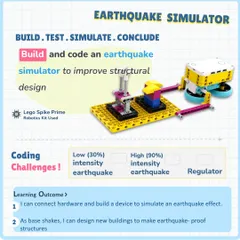
Student STEM Projects: LEGO Robotics & Coding Showcase
More from Tech Education for Kids & Teens by SP Robotic Works
More services by SP Robotic Works