Inside Our Robotics Classrooms at ROBO-G
See what happens when kids get their hands on technology. From building their first LEGO model to debugging code, every session is built around curiosity, problem-solving, and plenty of aha moments.
A student programs her LEGO robot using a tablet, an everyday scene from our year-long programs where kids learn to connect code with physical action.
A young student carefully assembles her LEGO creation, showing the focus and fine motor skills that our hands-on programs help develop.
This student is testing the code for his wheeled robot. Our classes provide ample opportunity for students to experiment and see the immediate results of their programming.
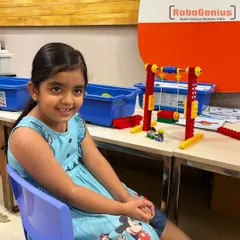
A young learner works with a LEGO WeDo kit, getting an early introduction to simple machines and programming concepts with guidance from an instructor.
Two students collaborate on a project, following instructions from a workbook. Our programs encourage teamwork and peer-to-peer learning.
Three students test their robots simultaneously, learning about navigation and sensor interaction in a friendly, competitive setting.
Students from Vidyashilp Academy are deep in concentration during our after-school program, learning to build complex models from instruction booklets.
An instructor provides guidance to a team of students at Vidyashilp Academy, fostering a collaborative and supportive learning environment.
A wide view of our classroom at Vidyashilp Academy, where students are spread out and engaged in their individual and group LEGO projects.
A student at Vidyashilp Academy carefully follows the instructions to build his model, developing patience and attention to detail.
About A Day at ROBO-G
You will not see rows of kids staring at a whiteboard here. Instead, you will find them at shared tables, working in pairs to troubleshoot gear ratios or code a sensor to trigger a movement. It gets noisy and sometimes messy when a robot does not behave, but that is exactly where the real learning happens. We keep batch sizes tight, with just 8 to 12 students, ensuring every child gets the dedicated attention they need to bridge the gap between a broken line of code and a fully functioning machine.
How We Learn
Our approach is simple: learn by doing. Whether a student is using LEGO WeDo 2.0 to understand basic mechanics or programming a Spike Prime robot to navigate a course, they are in the driver's seat. We strip away the intimidating layer of pure theory and replace it with tactile, project-based work.
The Classroom Environment
We host sessions at our dedicated centers in Jakkur (North Bangalore) and near Whitefield. These spaces are designed for movement and collaboration. Students share tablets and kits, which forces them to communicate, negotiate, and work as a team. Our instructors act more like facilitators than traditional teachers. They walk around, ask questions, and guide students toward their own solutions rather than just giving the answer.
Why It Works
- Small Batch Focus: With a limit of 12 students per session, no child gets lost in the crowd.
- Real Tools: We use industry-standard education kits including LEGO Mindstorms and Arduino, which gives kids experience with real-world hardware.
- Failure is Part of the Process: When a program crashes or a gear slips, that is a success story for us. It teaches resilience and logic, skills that stick long after they leave the classroom.
Whether your child is 4 or 16, our programs are built to grow with them, moving from screen-free coding basics to complex competition-level robotics.
Similar work from other experts
Browse through Curated picks from other experts on mytribe
Inside the Robomations Classroom
 12
12
Hands-On Robotics and STEM Classes in Bengaluru
Where Kids Build, Code, and Grow Together
Our STEM Learning Environment: Where Innovation Happens
 53
53
Inside Our Maker Labs: Robotics & Coding in Action
Robotics and Coding Classes for Kids
More from Robotics Camps & Workshops by ROBO-G