Our Asana Practice: Movement & Breath
Yoga is not just exercise; it is an inquiry. We move through Hatha and Yin to listen to the body, focusing on breath and steady alignment rather than perfect shapes.
Yoga is a journey from information to knowledge, and finally to wisdom. This video shows our students in a group class moving through Parsvakonasana (Side Angle Pose), applying what they've learned to transform instruction into embodied experience.
This short instructional video demonstrates that a "perfect" pose is not the goal. Whether you are in a modified Parsvottanasana (Pyramid Pose) or a deeper expression, a stable and steady asana at any stage is enough. We encourage you to enjoy the evolution of your practice.
A demonstration of a simple Surya Namaskar (Sun Salutation) sequence on a quiet veranda. This foundational flow links movement and breath, warming up the body and focusing the mind, and is a cornerstone of our daily practice.
Arm balances like Eka Pada Bakasana (One-Legged Crane Pose) require a blend of strength, focus, and confidence. This video shows the steady engagement and focused breath needed to find stability and hold the posture, reminding us to move with patience and awareness.
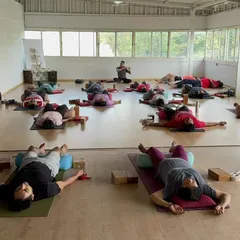
After an active practice, we rest in Savasana (Corpse Pose). This is a vital moment for integration, allowing the body and mind to absorb the benefits of the asanas. Here, our group finds stillness together in the shala.
To prepare for deeper backbends, we first work on foundational poses like Bhujangasana (Cobra Pose). This image shows the correct alignment, focusing on using back strength to lift the chest while keeping the hips grounded.
Urdhva Mukha Svanasana (Upward-Facing Dog) is another key posture for building spinal flexibility. Here, the practitioner demonstrates lifting the hips and thighs off the mat, engaging the legs and opening the chest, a progression from Cobra Pose.
For those finding a full Ustrasana (Camel Pose) challenging, we suggest modifications like bringing the hands to the hips for support. This allows you to experience the heart-opening benefits of the backbend safely and without strain.
In poses like Parsvakonasana (Side Angle Pose), we encourage modifications to ensure proper alignment. Here, the hand is brought inside the foot, helping to open the hips effectively without compromising the stability of the posture.
This image shows a beginner's approach to the side bend in Upavistha Konasana (Wide-Angled Seated Forward Bend). The focus is on length and breath, not how deep the bend is, making the posture accessible and beneficial for all levels.
About Our Asana Practice: Movement & Breath
You will notice we prioritize modification over perfection in every session. Whether it is bringing your hand inside the foot in Parsvakonasana or using props to find stability in a backbend, we teach you to listen to your body first. If you cannot breathe fully in a posture, you are not practicing yoga; you are only performing. We guide you to move from that place of ease, not force.
Our approach to asana is rooted in the principle of Sthira Sukham Asanam—the posture should be steady and comfortable. We do not chase the aesthetics of a pose. Instead, we use Hatha and Yin styles to explore the body's boundaries with curiosity rather than competition.
Why Movement and Breath Matter
When you force a pose, the body resists. When you breathe, it expands. We teach students to find that middle ground where the mind settles and the body opens. In our morning Hatha sessions, we build heat and strength through conscious movement. In the evening, we slow down with Yin Yoga, allowing the connective tissues to release. Both practices are designed to help you build awareness on the mat that you can carry into your daily life.
The Role of Modifications
A pose is only as good as the intention behind it. If you struggle to hold a posture, you lose the connection to your breath. We encourage students to modify heavily—whether that means using blocks, bending knees, or adjusting hand placements—to ensure the alignment serves your unique anatomy. This is how you cultivate a long-term practice that supports you at any stage of life, rather than one that burns you out.
Moving Beyond Doing
We often fall into the trap of thinking yoga is about what we can 'do.' We invite you to shift that perspective toward 'being.' In the silence of the shala, during a spinal twist or a restorative pose, you have the space to witness your own mind. This is where the physical practice transforms into Sadhana. You are not just working on flexibility; you are learning to respond to discomfort with patience, a skill that serves you long after you leave the mat.
Similar work from other experts
Browse through Curated picks from other experts on mytribe
Personal Sadhana and Ashtanga Yoga Classes in Bangalore
Mat Yoga: Vinyasa Flow & Hatha Foundations
Yoga Asana, Flow & Breathwork Sessions
Hatha and Vinyasa Yoga Flows in Bengaluru
Classical Hatha Yoga: Foundational Asanas & Flows
Yoga Asanas and Flows for Stability and Strength
More from Yoga Retreats by Pratyaksha Yoga
More services by Pratyaksha Yoga