Designing Resorts That Live With the Landscape
Creating a resort is not about building on land, but learning from it. We design lakeside and hillside retreats that feel as though they grew from the terrain itself.
A collage showcasing different facets of the Club Mahindra Resort in Tungi, Lonavala. The design uses natural stone and timber to mirror the dry, rural climate, while carefully detailed wooden overhangs provide shade and frame the stunning landscape views.
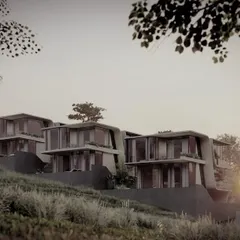
The Club Mahindra Tungi Resort, a lakeside retreat designed to be shaped by its landscape. The structure sits quietly overlooking Pawna Lake, with angled roofs and expansive windows that draw the scenery inward, creating a seamless connection between the built form and the natural terrain.
An architectural section drawing of the Club Mahindra Tungi Resort. This illustrates how the building is sited on the sloping terrain to maximize views of Pawna Lake while minimizing its impact on the landscape, with elevated walkways connecting different levels.
The serene courtyard of the spa at Club Mahindra, Lake Pawana. The design uses water as a reflective surface to amplify the sense of peace, with minimalist white colonnades and strategically placed greenery creating a tranquil, enclosed world for relaxation.
The original site plan for the Fort Aguada Beach Resort in Goa from 1973. This archival drawing shows my early commitment to context-responsive design, where the hotel's layout follows the natural contours of the coastal terrain to preserve the logic of the landscape.
An illustrative sketch of the Fort Aguada Beach Resort, showing how the built forms are integrated into the hillside and coastline. The goal was not for the building to disappear, but for it to continue the natural flow of the terrain, a principle that still guides my work today.
Exploring the use of organic, flowing curves in an upcoming hospitality project. This design concept moves away from rigid lines to create a softer, more natural architectural form that responds to its environment and creates unique spatial experiences.
About Lakeside & Hillside Resorts
We begin every project with deep site analysis, mapping topography, wind paths, and solar angles before a single wall is sketched. This ensures our resorts, such as our work at Club Mahindra Tungi, do not simply sit on the land but actively frame the views and maintain the natural contours of the site.
Architecture in hospitality requires a delicate balance between guest comfort and the natural environment. Our philosophy is rooted in context-responsive design. We do not flatten hills or fill lakeshores; we work with the existing gradients to create structures that feel native to their setting.
The Methodology of Context
When we approach a lakeside or hillside project, our first step is to read the landscape. For our Fort Aguada Beach Resort project, this meant laying out the structures to continue the logic of the natural terrain rather than imposing a rigid grid. This approach reduces excavation costs, preserves local flora, and naturally enhances the guest experience by ensuring privacy and optimal orientation toward the sun and wind.
Integrating the 'Scrum' Process
We apply our proprietary 'Scrum' planning process to resort development to eliminate the ambiguity often found in large-scale projects. This involves:
- Collaborative Workshops: Intensive sessions with stakeholders to lock the design brief early.
- Democratic Design Voting: Aligning project priorities to prevent expensive changes later.
- Feasibility Reporting: A data-backed approach to site analysis that includes wind tunnel simulations and sun-path mapping.
Material and Sensory Integration
We use indigenous materials like Basalt stone and local timber to ensure the architecture ages gracefully alongside its environment. By designing transition spaces like verandahs and open courtyards, we blur the boundary between the built form and the wild. Whether it is an eco-lodge near a forest or a resort overlooking a lake, our designs are engineered to be quiet, durable, and deeply rooted.
Similar work from other experts
Browse through Curated picks from other experts on mytribe
 4
4
Hospitality & Resort Architecture Services
Sustainable Resort and Retreat Design in the Hills
 12
12
Resort Architecture and Retreat Design
 11
11
Hospitality Architecture Rooted in the Landscape
 4
4
Resort and Landscape Master Planning Services
 10
10
Hillside and Coastal Masterplanning Designs
More from Hospitality & Leisure Architecture by IMK Architects