Sustainable Residences in Bengaluru: Earth, Brick and Nature
Architecture that breathes with the landscape. We design energy-efficient homes using raw materials like CSEB, rammed earth, and exposed brick, grounded in Indian climate-responsive principles.
The "Aamra" farmhouse was designed to be nestled within a canopy of mango trees, overlooking the Banthamari state forest. The goal was a simple, maintenance-friendly house that reflects a life connected to the bucolic landscape.
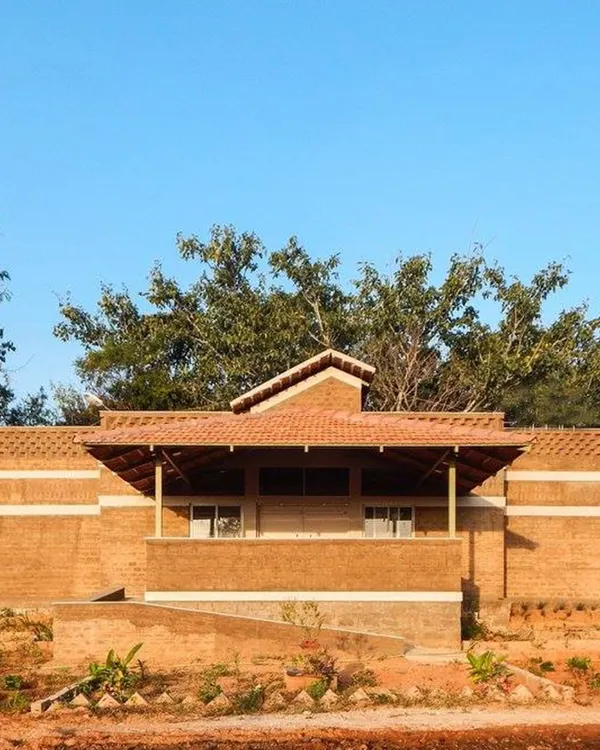
The exterior of "Aamra," where the L-shaped structure opens up to a lush lawn and mango orchard. The design is based on the 'Jagli katte' concept, a traditional verandah space that runs along the boundary, creating numerous semi-open areas for leisure.
A key feature of the "Aamra" project is the integration of existing nature. This large mango tree becomes the centerpiece of the courtyard, with a built-in seating area that encourages outdoor living and interaction.
Children playing on the custom-designed concrete seating around a mango tree at the "Aamra" farmhouse. These moments show how architecture can create spaces for unhurried activities and connection with family and nature.
A child's bedroom in the "Aamra" residence, featuring a deep window seat for reading. The high clerestory windows bring in ample north light, while the large sliding doors open the room completely to the surrounding mango farm.
The open-plan kitchen and dining area of "Aamra," where the service and served spaces blend. The central island, with its cement oxide top and upcycled pantry shutters, acts as the social heart of the home.
The deep verandah or 'Jagli' at "Aamra" is defined by an inclined wall and bright yellow louvered shutters. This semi-open space provides shade and a seamless transition between the interior and the mango grove outside.
A view through the colonnade of CSEB pillars at "Aamra." The polished floor reflects the exposed brick of the staircase wall, showcasing the raw, honest material palette of cement, earth, and stone.
The corridor at "Aamra" demonstrates the interplay of textures. The smooth cement oxide finish on the walls contrasts with the rough texture of the exposed brick jaali, creating a visual and tactile journey through the house.
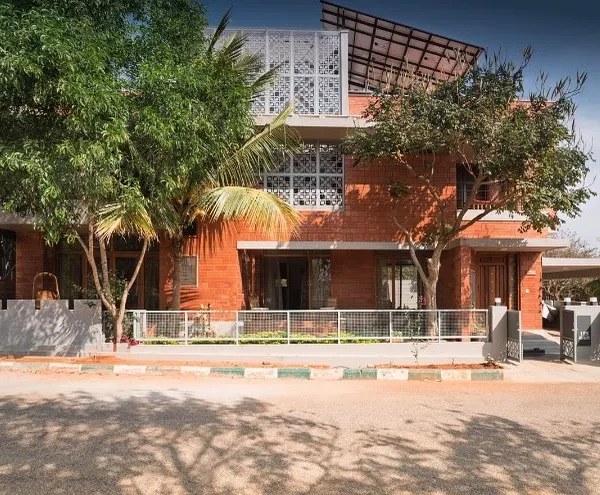
The "Breathe" residence, an award-winning earth house, is defined by its curved jaali wall. This feature is not just aesthetic; it provides natural ventilation and invites birds to nest, creating a living, breathing skin for the building.
About Sustainable Residences: Earth, Brick & Nature
When we approach sustainable design, we aren't simply selecting eco-friendly materials, but rethinking the entire micro-climate of your site. In our 'Aamra' farmhouse project, for example, we utilized a traditional 'Jagli katte' or verandah along the perimeter. This is not merely an aesthetic addition; it acts as a transition zone that shades the internal walls and encourages cross-ventilation, drastically reducing the need for mechanical cooling even during the peak of summer. We focus on these structural decisions because they impact your comfort and energy consumption long after the build is finished.
Our Approach to Conscious Living
At Betweenlines, we view architecture as a dialogue between the building, the landscape, and the people who inhabit it. We avoid standardized solutions, preferring to let the site dictate the form. Whether you are building on a constrained urban plot or a vast farmhouse site, our process remains rooted in three core principles: material honesty, climate-responsive geometry, and spatial efficiency.
Materiality and Craft
We favor materials in their raw state. Using Compressed Stabilized Earth Blocks (CSEB) and rammed earth allows us to construct walls that have high thermal mass, keeping interiors naturally cooler. We combine these with exposed kiln bricks, cement oxide flooring, and reclaimed wood. These materials require less energy to manufacture than modern alternatives and age with a grace that artificial finishes cannot replicate.
Designing for the Indian Climate
Our residential designs incorporate traditional elements to solve contemporary problems. Deep chajjas (overhangs), jaali screens, and courtyards are not decorative; they are functional tools we use to manage light and privacy. By carefully studying the sun path and wind patterns of your specific site, we orient the house to maximize natural light while shielding the interiors from harsh direct heat.
The Collaborative Process
We believe the best results come from rigorous collaboration. We document every stage, from the initial climate analysis to the final construction details. We are transparent about constraints—whether it is a Vastu requirement or a challenging topography—and we treat these not as obstacles, but as design opportunities. Our team provides comprehensive support, coordinating with specialized craftsmen to ensure the details we draw on paper are realized with precision on-site.
Similar work from other experts
Browse through Curated picks from other experts on mytribe
 46
46
Earthy & Eco-Conscious Home Designs in Bengaluru
Sustainable Rammed Earth Homes
 4
4
Vernacular & Earth Architecture Projects in Bangalore
 5
5
Homes That Breathe: Sustainable Design in Bangalore
 35
35
Climate-Responsive Home Designs and Sustainable Architecture
 10
10
Exposed Brick Residence Designs in Bengaluru
More from Architectural Design by Betweenlines
More services by Betweenlines