On the Wing: Capturing the Marvel of Bird Flight
Flight is the ultimate expression of freedom, but capturing it requires understanding the mechanics behind the motion—from the heavy downstroke of a pelican to the precise hover of a sunbird. Here, I share the aerial artistry I have tracked across Indian skies.
A Great White Pelican comes in for a landing, its massive ten-foot wingspan spread wide and feet acting as landing gear. These birds are remarkably buoyant and graceful fliers for their size.
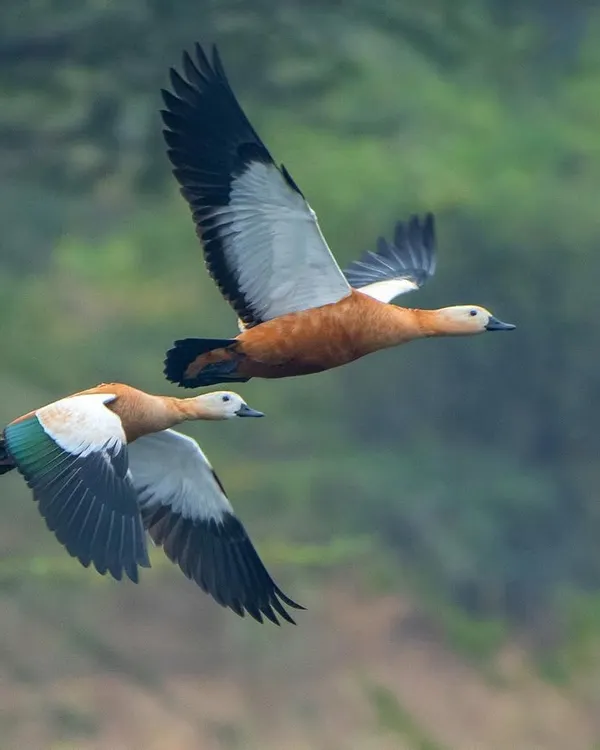
An Indian Spot-billed Duck in a perfect moment of flight, showcasing the iridescent green speculum on its wings. The rhythmic downstroke and upstroke of the wings is the secret to the marvel of flight.
The interplay of wing feathers with air is captured as a Spot-billed Duck glides over the water. Each movement is a seamless preparation for the next, a tandav of weightless feathers and invisible air.
A Vigor's Sunbird hovers mid-air, a type of flight requiring immense energy and control. This maneuver is essential for the bird to reach nectar deep within flowers that cannot be accessed from a perch.
Captured in the act of feeding, this sunbird demonstrates the precise hovering flight needed to extract nectar. It is a dazzling display of energy, consuming energy to acquire energy.
A Lesser Whistling Duck prepares to land in a wetland, its wings cupped to brake its speed. Landing is a complex maneuver, a kind of backward orientation of taking off.
A Cattle Egret with wings spread wide, feet outstretched, as it comes in to land on a dead branch. The use of wings, feet, and tail as brakes and rudder is a masterclass in aerodynamics.
An Indian Spot-billed Duck skims the water's surface as it lands. This action shot shows the transition from the medium of air to the surface of water, a critical moment of control.
The brilliant iridescent speculum of a Spot-billed Duck is on full display. Depending on the angle of light, these patches can flash from brilliant green to indigo-blue, a magical play of color.
An Indian Spot-billed Duck flaps its wings in the water, revealing the stunning green speculum. This patch of color on the secondary flight feathers is a striking feature of many duck species.
About On the Wing: The Marvel of Flight
Landing is rarely just a graceful touch-down; it is a complex, high-speed calculation. When I photograph a Spot-billed Duck settling on water, I’m waiting for the moment they flare their wings, using their tail and feet as a rudder to brake. It is a tandav of feathers against invisible air, and that technical precision is what differentiates a snapshot from a story.
Nature is a relentless innovator, and nowhere is this clearer than in the physics of flight. For years, I have documented the mechanics of avian movement, from the blistering speed of a sunbird’s hover to the rhythmic, powerful wingspan of a Great White Pelican.
My approach to avian photography is not about simply 'getting the shot.' It is about understanding the 'why' behind the movement. Why does a duck flare its wings just so? Because it is managing drag and lift in a fraction of a second. When you look at the iridescent speculum on a Spot-billed Duck, you aren’t just seeing colour; you are seeing an evolutionary adaptation for signalling in flight.
I capture these moments with the same care I apply to my writing. Whether it is the theatrical formation of a pelican squadron or the solitary hover of a sunbird, the goal is to show the sheer effort behind what looks like effortless grace. This documentation serves a dual purpose. It celebrates the biological engineering of our wild cousins, but it also highlights the fragility of their domain. Many of the wetlands where I capture these flight sequences are under constant threat. By presenting the 'marvel of flight' in high-resolution archival prints or discussing the technique during my workshops, I hope to translate that beauty into genuine concern. Every time we watch a bird take wing, we are witnessing a miracle of biology—let’s ensure the stage remains for them to perform.
Similar work from other experts
Browse through Curated picks from other experts on mytribe
Capturing the Vibrant Behavior of Flycatchers and Kingfishers
 29
29
Birds in Action Photography in Mumbai
 93
93
Bird Photography: Capturing India's Winged Wonders
 87
87
Avian Portraits and Raptor Photography
 7
7
Capturing Action: Birds in Flight & Motion
 10
10
Featured Wildlife Photography and Best Action Shots
More from Wildlife & Nature Photography by Sunjoy Monga
More services by Sunjoy Monga