Nurturing Young Talent in Hindustani Classical Music
Age is no barrier to the pursuit of shastriya sangeet. At Sangeet Sadhana, we guide young students to build a strong foundation in swara, laya, and taal through the time-honored Guru-Shishya parampara.
A heartwarming moment from one of our youngest student's first music session. Here, little Abira is introduced to the fundamental concepts of Aroha and Avroha in a playful and encouraging environment, marking the beginning of her musical journey.
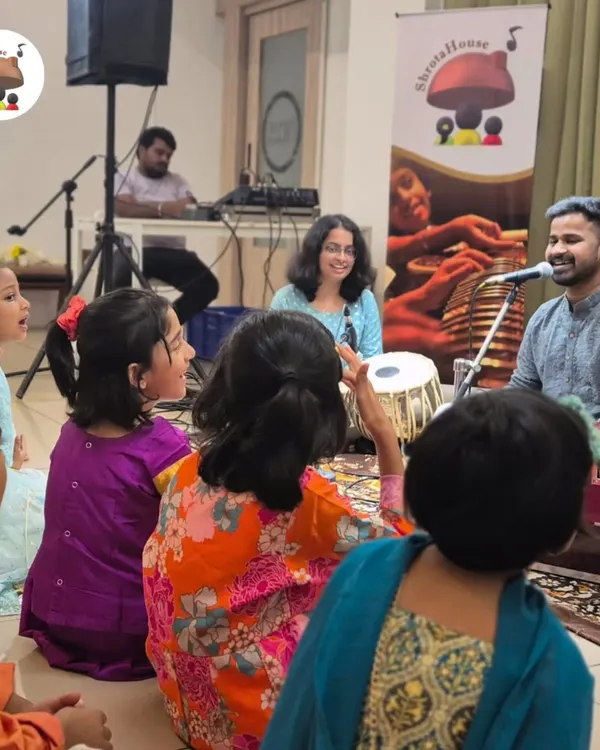
Our young students attempt a composition in Raag Durga, accompanied by live tabla. This pentatonic raga, evoking love and devotion, is taught with a focus on group coordination and understanding its unique melodic structure.
Two of our youngest students, aged 5 and 6.5 years, practice a Sargam Geet in Raag Bhairav. It is a delight to see these best friends learning together, developing their skills in pitch and rhythm with focus and joy.
A young student practices Alankar patterns, a fundamental exercise for all vocalists. This focused riyaz helps reinforce the position of swars, improves vocal clarity at different speeds, and strengthens breathing techniques from a young age.
At the tender age of 6, our student Tashi is being introduced to a complex raga. She learns by imitating the guru, developing a fine sense of hearing for pure swaras, which is the foundation for future creative exploration in khayal gayaki.
We believe every child has inherent musical potential. Here, 3-year-old Jayttri demonstrates a fine sense of hearing for pure swaras after just a few classes, showcasing how our fun and disciplined approach builds a strong foundation early on.
When swaras become your friends, your heart starts to sing. This image captures the joy and focus in one of our children's group classes, where we celebrate the bond between music and friendship.
About Our Young Prodigies: Nurturing Future Talent
Our approach to teaching young children balances strict discipline with gentle guidance. We do not rely on dry, abstract theory. Instead, we build an intuitive sense of pitch by having students engage with foundational alankars and sargam exercises. This method ensures that even our youngest learners, some as early as three years old, develop the ability to hear and replicate pure swaras, which forms the bedrock of their future vocal training.
The journey into Hindustani classical music for a child is an exercise in patience. In our Koramangala classrooms, we emphasize that mastering swara, laya, and taal is not a process to be rushed. By grounding students in the traditional Guru-Shishya parampara, we allow them to grasp the complexity of ragas like Yaman or Bhairav through experiential learning rather than mere imitation.
We structure our sessions to accommodate different developmental stages. For the youngest students, learning is tactile and repetitive, focusing on the basics of voice culture. As they grow, we introduce the formal grammar of Khayal Gayaki, including vilambit and drut laya, ensuring they understand the history and emotion behind the compositions.
Parents often ask about the transition from play to serious study. This transition happens naturally as a child's understanding of taal deepens. We prioritize regular riyaz, which improves vocal clarity and strengthens breathing techniques. Whether students join our offline batches in Bangalore or our online sessions, they receive structured, consistent feedback from our instructors, ensuring that the legacy of Hindustani shastriya sangeet continues with the next generation.
Similar work from other experts
Browse through Curated picks from other experts on mytribe
Master Indian Classical Vocals
Hindustani Classical Training: Build Your Foundation
 16
16
Joyful Indian Classical Music Classes for Kids
 12
12
Hindustani Music Classes for Kids: Building Confidence & Foundation
Authentic Carnatic Vocal Classes in Bangalore
Mastering Indian Classical Vocals
More from Hindustani Vocal Music by Sangeet Sadhana
More services by Sangeet Sadhana