Tech Insights & Computational Thinking Facts
Think coding is only about staring at a laptop? Think again. From NASA’s puzzle training to the binary math behind your favorite games, discover the logic that powers the technology around us.
Fun Fact: NASA trains astronauts with puzzles before technology. They learn to solve problems without relying on tools, because in space, critical thinking is the one thing that cannot fail. I apply the same principle to learning.
Quick Fun Fact: The first programming language was introduced in 1956. Before that, programmers worked directly with 0s and 1s. It’s a great reminder that coding is fundamentally about logic, not just fancy screens.
Did you know the computer that guided the Apollo moon landing had less memory than a kid's video game today? It shows that powerful outcomes are the result of brilliant thinking, not just powerful hardware.
A Christmas-themed computational thinking fact! Gift wrapping requires recognizing patterns to ensure a neat presentation, showcasing the real-world application of pattern recognition skills.
Here's a myth and fact about the Rubik's Cube. You don't need advanced math to solve it; you need to learn and memorize algorithms, which is a great exercise in computational thinking.
I often get asked how parents can support their child's interest in coding at home. I suggest providing access to educational apps, enrolling them in classes like mine, or participating in coding-related activities together.
About Tech Insights & Fun Facts
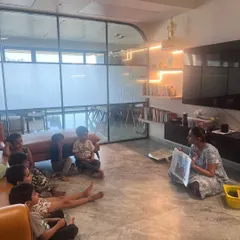
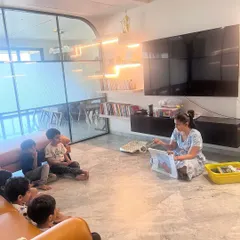
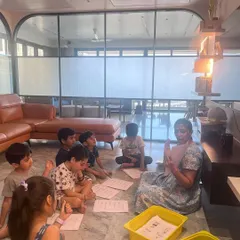
Most people assume coding requires a laptop, but the best coders start with paper, pens, and puzzles. We teach kids to decompose problems using real-world examples, like how gift-wrapping is just pattern recognition or why a Rubik’s cube is an algorithm in action. By breaking down these concepts before they touch a screen, we ensure they understand the logic, not just the interface.
Why Computational Thinking Matters
Coding is often mistaken for just typing syntax, but the real power lies in computational thinking—the ability to break complex problems into manageable steps. Whether it is sorting laundry or navigating a maze, these are the same processes computers use to execute tasks.
Turning Facts into Skills
In our workshops, we do not just share trivia; we use it as a learning tool:
- Binary Basics: We use beads and simple bracelets to explain how computers communicate in 0s and 1s, making abstract concepts concrete.
- Algorithm Design: Using floor grids, kids learn to program 'human robots' to navigate mazes, teaching them the importance of clear, sequential instructions.
- Debugging Logic: We use mystery games to show that mistakes are not failures; they are just part of the debugging process.
The Future is Logic
Understanding these fundamental building blocks prepares children for a future where technology will constantly evolve. By teaching the 'why' before the 'how,' we give your child a foundation that does not become obsolete. Whether or not they become a software engineer, the ability to think logically and solve problems creatively is a skill they will carry for life. Join us to see how we make these concepts stick through play.
Similar work from other experts
Browse through Curated picks from other experts on mytribe
Coding Without Screens: Logic & Robotics for Kids
 26
26
Understanding the World of Tech: Robotics and Coding Basics for Kids
 69
69
Understanding Core Coding Concepts & Logic
STEM Fun Facts & Robotics Insights
Why Coding is a Superpower for Kids
 23
23
Core Concepts in Coding, Robotics, and AI
More from Screen-Free Computational Thinking Workshops by Code-Riite
More services by Code-Riite