The People Tree House: A Sanctuary for Harmonious Living
This 7,000 sqft Noida residence, Ashvattha, integrates human living spaces with local wildlife. Built around a sacred Peepal tree, it balances luxury with deep sustainability.
A complete view of the People Tree House, showing the interplay between the built environment and natural elements like the central water feature and extensive plantings.
This animated walkthrough shows how the five floors of the People Tree House are organized, from the basement work areas to the rooftop terrace, all designed around the central Peepal tree.
A large, curved skylight floods this double-height volume with natural light, while also directing rainwater into a storage tank, showcasing the fusion of aesthetic form and sustainable function.
A curved balcony with floor-to-ceiling glass offers an expansive view, connecting the inhabitants with the sky and the surrounding environment.
The open-plan living area features an integrated kitchen with exposed brick vaults, demonstrating how structural elements become part of the interior aesthetic.
Another perspective of the kitchen and living space, highlighting the unique texture of the brick vault ceiling against the clean lines of the modern kitchen.
This bathroom is a study in color and texture, with a custom red cement bathtub, handmade tiles, and arched wooden shelving, creating a warm, rustic, and luxurious feel.
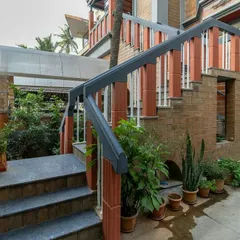
A staircase with wooden treads and a bright red handrail runs alongside a massive wall of locally sourced random rubble stone, a key material in the project.
A detailed shot of the staircase against the textured stone wall. The red handrail is not just a design element; it also functions as a pipe to channel rainwater.
The red handrail is a functional sculpture, guiding movement through the space while channeling overflow water from the upper levels to an underground storage tank.
About The People Tree House: A Sanctuary for Harmonious Living
The most functional piece of art in this house is the bright red handrail lining the staircase. It is not just for support, it acts as a pipe system that channels rainwater from the roof down to our underground storage tank, merging sculptural aesthetics with essential water harvesting.
I designed this 7,000 sqft Noida residence, Ashvattha, as a radical departure from the standard urban home. It is built for a quiet, long-term co-existence with the local ecosystem. The core of the house is the sacred Peepal tree, which dictated the site layout and orientation.
We utilized load-bearing brick vaults and random rubble stone walls, not for their rustic appeal, but because they provide superior thermal mass. This keeps the interior naturally cool in the Delhi summer without relying heavily on air conditioning. The layout is intentionally volumetric, with double-height spaces and skylights that serve as passive ventilation shafts, drawing fresh air through the house.
The project is a deliberate attempt to lure biodiversity into the urban jungle. The indoor water bodies and carefully selected indigenous plants provide a nesting and feeding ground for local birds and insects. Even the ceiling details, featuring red earthen pots, are integrated nesting spots. This is not about surface design, it is about creating a structure that functions as a living, breathing component of the environment.
Similar work from other experts
Browse through Curated picks from other experts on mytribe
 33
33
Biophilic & Sustainable Residences in Delhi NCR
Project Deep Dive: The Aangan Courtyard House
 7
7
The Tree House: Nature-Inspired Architecture in Delhi
 22
22
Eco-Friendly Home Design Inspired by Nature
 26
26
Sustainable and Biophilic Residential Designs
 14
14
Biophilic & Climate-Responsive Architectural Design
More from Bespoke Interior Architecture & Design by Archiopteryx
More services by Archiopteryx