Smart Home and IoT Projects Built by Kids
Watch our students turn sensors and logic boards into clever gadgets. From smart dustbins to automated plant waterers, these projects bring technology to life.
This team explains their IR-based visitor counter, a practical device used to count people or objects passing by. They break down the components, including the microcontroller and ultrasonic sensors, and its real-world use at places like toll gates.
These students present their innovative IR-based hand hygiene station, featuring an automatic hand washer and hand dryer. They demonstrate how sensors trigger the water flow and the fan, a great example of practical, automated solutions.
Two students demonstrate a parking sensor they built, using an Arduino, ultrasonic sensor, and LEDs. They explain how different colored lights indicate the proximity of an object, a project with clear real-world applications for vehicle safety.
This team presents a solar-powered motion sensor that uses a PIR sensor and Raspberry Pi to detect movement. They explain how it can be used for security or wildlife tracking, showcasing their knowledge of sustainable technology.
Here, students demonstrate their automatic plant watering system. They explain how a soil moisture sensor detects dryness and triggers a pump, a smart and sustainable solution for plant care powered by a solar panel.
A student showcases his sound-activated "safe door" project. He explains how a sound sensor sends a signal to an ESP8266 module, which then controls servo motors to open and close the doors, a clever application for hands-free access.
This team demonstrates a sequential LED lighting system controlled by an ultrasonic sensor, designed to function like a parking assist system. As a toy car gets closer, more LEDs light up and a buzzer sounds, showing a practical use of distance sensing.
This group of students presents their "Enviro Time" smartwatch prototype built with a Raspberry Pi. It uses an MQ2 sensor to measure air quality and a BMP280 sensor for altitude and temperature, a fantastic project combining wearable tech and environmental monitoring.
A fifth-grade student explains her solar-powered buzzer sensor project. She details how the system uses a Raspberry Pi and solar-charged batteries to detect motion and sound an alarm, making it effective for home security day and night.
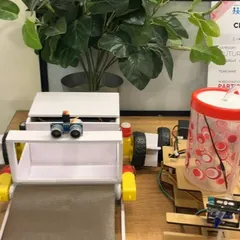
A fourth-grader demonstrates his security car system. He explains how an ultrasonic sensor detects a nearby object and triggers a loud buzzer, a simple but effective alarm system built from basic robotic components.
About Smart Home & IoT Projects
Most parents worry that coding and IoT are too abstract for kids. Here, we prove otherwise by focusing on tangible results. A student does not just learn about a soil moisture sensor, they build a system that actually waters their plant when it gets dry. It is this switch from learning theory to saying 'I built that' that makes the concepts stick.
How We Make Tech Tangible
We believe the best way to understand the Internet of Things is to build it. In our camps, students move away from theory and start working with real-world hardware like Arduino boards, ESP8266 modules, and Raspberry Pi.
Projects That Solve Problems
It is not just about making LEDs blink. We guide students through projects that serve a real purpose:
- Automated Dustbins: Using IR sensors to detect hands and trigger a motor-operated lid.
- Smart Security: Creating motion-triggered alarms or 'safe doors' that only respond to specific inputs.
- Environmental Monitoring: Building 'Enviro Time' smartwatches that measure air quality and temperature.
- Sustainable Automation: Designing solar-powered plant watering systems that conserve resources.
The Learning Journey
Each project follows a simple path: identifying a problem, selecting the right sensor, writing the logic to control it, and debugging the hardware connections. When a student builds a parking assist system that warns them as a car gets closer, they are not just memorizing code. They are learning how sensors, microcontrollers, and logic work together in harmony. This approach transforms a complex topic like IoT into a series of exciting, achievable challenges.
Similar work from other experts
Browse through Curated picks from other experts on mytribe
Smart Home Innovations Built by Kids
Hands-On Robotics and Coding Projects
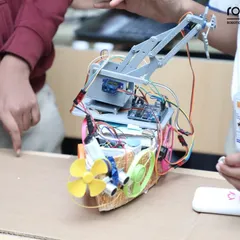
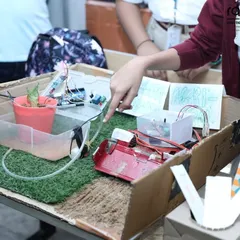
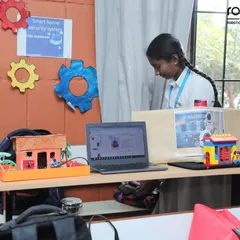
Student Robotics Projects: From Code to Creation
 10
10
Electronics & Robotics Projects for Kids
 14
14
Student Robotics Projects: From Idea to Working Robot
Hands-on Electronics Workshops for Kids
More from STEM Summer Camps by Robomations
More services by Robomations