The Tiger's Domain: Documenting Central India’s Wildlife Corridors
Wildlife photography in Central India is not merely about finding the cat, but understanding its path. These images document the tigers and the fragile forest corridors they rely on for survival.
A tigress teaches her cubs to navigate their world, here seen drinking at a waterhole while one cub practices climbing. Protecting corridors is essential for such families to find new territory as the cubs mature.
A magnificent male tiger patrols his territory along a forest stream. This camera trap placement allowed me to capture his confident stride, a visual confirmation of his dominance in this part of the jungle.
An intimate, low-angle view of a tiger drinking from a waterhole, its gaze fixed on the camera. To get this shot, I partially submerged my camera trap, offering a unique perspective into the animal's world.
A tiger indulges in a "natural spa," soaking in a cool waterhole to escape the summer heat. Observing and documenting these natural behaviors provides crucial insight into the species' needs and habits.
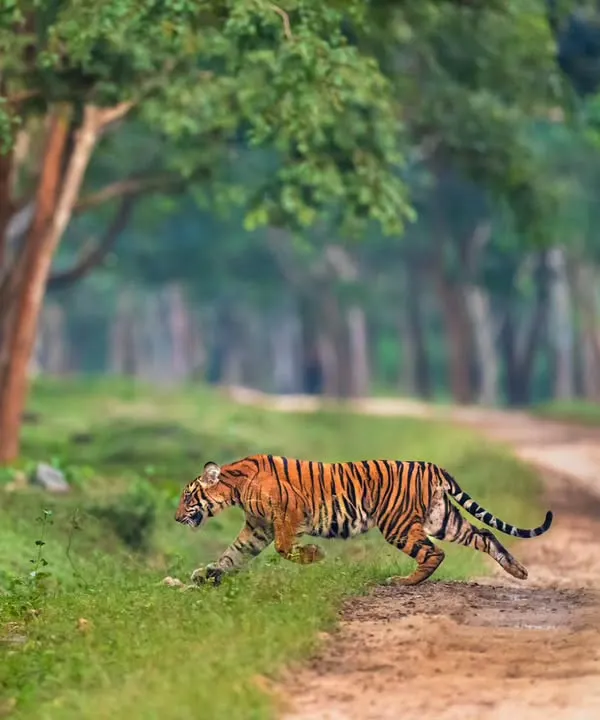
A tiger on the move, captured in the dappled light of the forest. This image shows the animal in its element, moving through the dense undergrowth of its Central Indian habitat.
A tiger pauses by a tree, its direct gaze a powerful reminder of its presence. My work aims to foster respect for these animals, emphasizing that their survival is intrinsically linked to our own.
This is the start of the 'Tiger Trail' series. A resident male tiger approaches the camera trap I set up along a known animal pathway, offering a clear, eye-level portrait.
Another tiger, likely a different male, investigates the same trail. The area around this scent-marking tree served as a communication hub for the local tiger population.
At night, a tigress rubs against the tree to leave her scent, a form of chemical communication. This behavior is crucial for mating and establishing territorial boundaries.
A male tiger sprays urine on the same tree, adding his own scent mark. Capturing this sequence of behaviors over several days provided a narrative of the unseen social dynamics of these solitary animals.
About The Tiger's Domain: Corridors of Central India
Many of these images are captured using custom-rigged camera traps placed along identified tiger scent-marking trees, rather than traditional safari photography. This method allows me to observe natural behaviors like territory marking and cub rearing without human presence, providing a scientifically accurate look at how these predators utilize forest corridors.
Why Corridors Matter
In the forests of Central India, the survival of the Royal Bengal Tiger depends on connectivity. When protected areas are isolated, tiger populations become genetically vulnerable. My work focuses on documenting these essential corridors—the green bridges between habitats that allow tigers to disperse, find mates, and establish new territories. These photos are not just portraits; they are evidence of how wildlife navigates the landscape when left undisturbed.
The Methodology: Beyond the Safari
Most wildlife photography relies on the 'jeep and guide' model, but that only captures a fraction of an animal's life. To truly understand the social dynamics of the jungle, I deploy passive infrared camera traps. This technique allows me to document nocturnal activities like scent-marking, interaction between different species, and the subtle cues of territorial disputes—behaviors that are rarely seen by human eyes. By leaving equipment in the field for weeks at a time, I capture the authentic rhythm of the forest.
The Human Impact
While these images showcase the tigers, the real story is one of coexistence. I work closely with local forest communities and field researchers to understand the human-wildlife interface. Conservation is not about fencing off nature; it is about recognizing the shared spaces where humans and animals interact. Through these documentation projects, I aim to create visual narratives that highlight the necessity of protecting these corridors, ensuring that both the tigers and the communities living alongside them have a sustainable future.
Similar work from other experts
Browse through Curated picks from other experts on mytribe
 20
20
The Great Cats: Phantoms of the Forest
 42
42
Royal Bengal Tiger Photography
Royal Bengal Tiger Photography
 30
30
The Tiger's Realm: Fine Art Wildlife Prints
 54
54
Tracking Tiger Legends: The Living History of the Wild
 23
23
Big Cats of the Jungle: Tiger & Leopard Photography
More from Conservation Storytelling & Visual Advocacy by Nayan Khanolkar
More services by Nayan Khanolkar