The Anatomy of Construction: Concrete, Form, and Light
Architecture is not merely the final enclosure. It is the physical manifestation of a logic. Here, we examine the raw, formative stages of construction, where the primary intentions of material honesty and structural integrity are established.
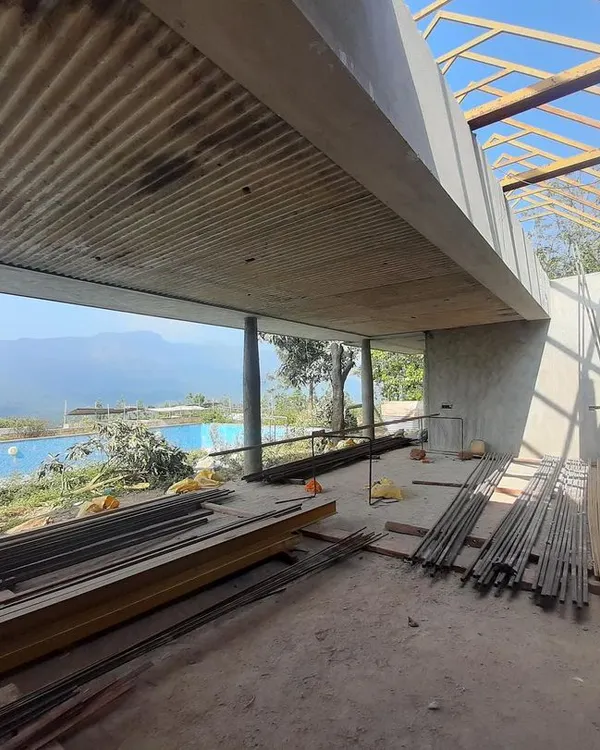
A view of the upcoming villas in Moradabad during construction. The image captures the contrast between the finished, heavy concrete cantilever and the daily life happening around the construction site.
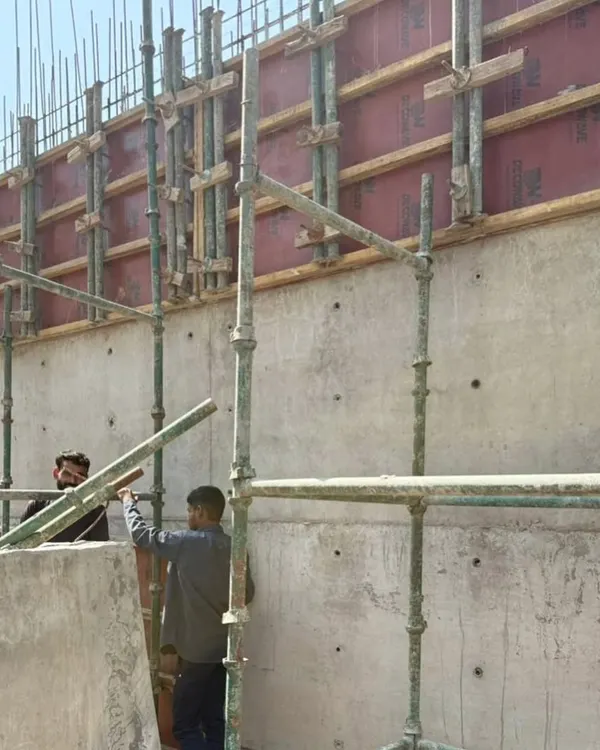
The raw, board-formed concrete walls of the Moradabad villa project. The texture of the wooden planks used for the formwork is permanently imprinted on the concrete surface.
A moment during the construction of the Moradabad villas, showing the scale of the concrete forms and a circular skylight opening.
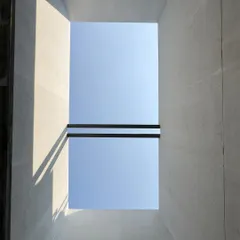
Looking up through a large circular oculus in the concrete roof slab of the Moradabad project. This element is designed to bring a dramatic column of light down into the interior space.
The "Stairwell to Heaven" under construction. This photo shows the base of the circular opening for a future staircase, surrounded by scaffolding and raw concrete.
The interior of the Moradabad villa, filled with a dense web of scaffolding. This temporary structure is necessary to support the formwork for the complex concrete shapes.
The play of light and shadow on an unfinished concrete wall. The diagonal shadows are cast by the scaffolding, creating a temporary geometric pattern on the surface.
A discussion on-site at the Moradabad project. Here, I am explaining a design detail next to a large concrete volume with a circular cutout.
A detail of a sculptural concrete beam cantilevering from a board-formed wall. This black and white photograph emphasizes the form and the stark contrast of shadow against the textured surface.
The same cantilevered beam element seen from a wider angle, with scaffolding still in place. This shows how such a complex form is supported during the concrete curing process.
About The Construction Process: Material and Form
True honesty in concrete architecture requires obsessive attention to the temporary support systems. Before the final wall stands, the formwork, rebar placement, and the specific cadence of the pour must be orchestrated to ensure the finish captures the grain of the wood and the intended light.
The act of building is a conversation with gravity and material. In our projects, such as the villas in Moradabad or residences in New Delhi, the construction process is as vital as the final form. We employ plank-shuttered concrete to imprint the tactile history of the formwork directly onto the wall. This is not decorative; it is a record of the construction event itself.
Every structural cantilever, every circular oculus, demands a rigorous coordination of engineering and craft. The dense web of scaffolding visible in these images is the invisible architecture that supports the final expression. We do not hide the labor behind plaster or cladding. Instead, we reveal the joints, the tie-rod holes, and the raw edges.
This approach necessitates intense site supervision. Senior architects oversee the casting process, ensuring the bush-hammered stone or the fair-face concrete aligns with the original vision. Whether implementing traditional techniques like Dhajji Dewari in mountainous contexts or modern modular precast elements, the logic remains constant: the structure must express its own creation.
For clients, this means a process defined by high-precision site work. It involves reviewing mock-ups for concrete texture, verifying structural integration of floating staircases, and planning service routing within the concrete shell itself. This is architecture stripped of artifice, where the beauty is found in the integrity of the build.
Similar work from other experts
Browse through Curated picks from other experts on mytribe
 12
12
Our Architectural Construction and Materiality Process
 55
55
From Blueprint to Building: Our Construction Journey
 13
13
The Art of Raw Materials: Exposed Concrete & Natural Stone
 57
57
Architectural Design Process: Sketches to Built Form
 18
18
From Sketch to Structure: Our Architectural Design Process
The Soul of Making: Our Architectural Process
More from Bespoke Residential Architecture by Matra Architects
More services by Matra Architects