Robotics Labs and Hands-on Coding Classes
We move beyond theory. Our labs are spaces for students to solder circuits, write code, and build working prototypes from the ground up.
A glimpse into our hands-on Python training. Our students learn to code by working on live projects, gaining practical skills in one of the world's most popular programming languages.
Inside our Young Engineers Club, students work on complex projects like this large-scale robot, getting hands-on with intricate wiring, mechanics, and assembly under expert mentorship.
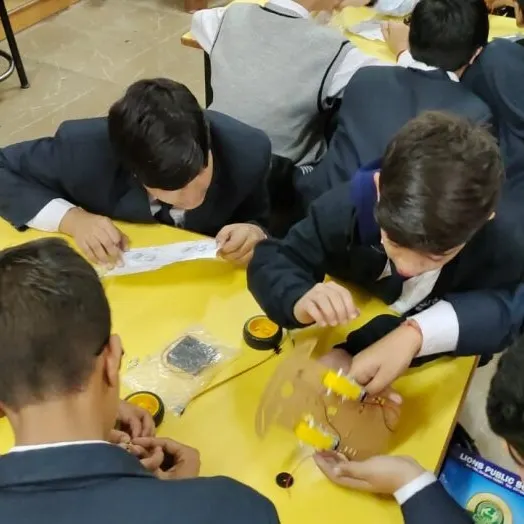
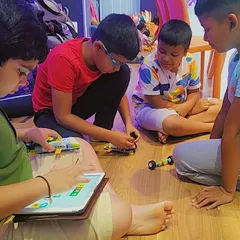
From whiteboard brainstorming sessions to testing their creations, our Young Engineers Club is where collaboration and innovation happen. Here, students are seen working on their custom-built robo-racers.
An example of a project built in our lab: a fully functional robotic arm. Students learn to design, build, and program mechanisms that can pick up and place objects with precision.
About Inside the Lab: Where Ideas Take Shape
In our lab sessions, you don't just watch a screen. You start with a blank mat and a kit of parts, and by the end, you are debugging your own Python code or wiring a sensor array. Whether you are five or fifteen, you get your own station to fail, learn, and finally get that machine moving.
At Science Kidz, we believe innovation does not need a fancy address, just the right environment. Our Makers Labs in Andheri, Kandivali, Lal Baug, Mulund, and Byculla are set up to mimic real engineering workspaces rather than traditional classrooms.
What happens in the lab?
- Mechanical Design: You start with CAD software. Before a single part is printed or cut, you design it.
- Electronics & Wiring: You get your hands on soldering stations, batteries, LEDs, and sensors. It is about understanding how components connect.
- Coding Logic: We do not just teach syntax. Whether you are using Python, Java, or Scratch, we focus on algorithmic thinking and flowcharts first. You write the logic, then test it on your robot.
- Testing & Iteration: The core of our methodology. You build a mechanism, test it on the competition mat, it fails, you fix the code, and you try again. This is where real learning happens.
We cater to students aged 5 to 19. If you are just starting, you will use LEGO SPIKE or WeDo kits to understand basic logic. If you are aiming for FRC or FTC competitions, you will work with aircraft-grade aluminum, DC motors, and computer vision using OpenCV. Everything we do is project-based. You come in, you pick up a kit, and you build something that works.
Similar work from other experts
Browse through Curated picks from other experts on mytribe
Inside the Lab: Hands-On Robotics & Building Process
 46
46
Hands-On Robotics and Coding Workshops
Robotics & Coding Classes for Kids
Robotics and Coding Classes for Kids
Real Robotics Projects Built by Our Young Innovators
See Robotics and STEM Learning in Action
More from Robotics & Tech Competition Training by Science Kidz
More services by Science Kidz