Natural Dog Socialization: Learning in a Pack
Dogs learn better from each other than they ever will from a human giving commands. In my cage-free home, your pup joins my Brat Pack to figure out social cues, boundaries, and how to just be a happy, balanced dog.
A proper greeting between a German Shepherd, a Boxer, and a Golden Retriever. Learning polite dog-to-dog communication is a key part of my socialization program.
This is a classic play bow, an invitation to a game. I help dogs understand and use appropriate body language to ensure all interactions are positive and fun.
Gentle wrestling and mouth-play between a German Shepherd and a Golden Retriever. This kind of interaction teaches bite inhibition and respectful play.
Even indoors, there's always time for a bit of fun. This video shows Kubo and Bruno enjoying a playful chase, a great way to release energy in a controlled environment.
Navigating shared spaces like a staircase is an important social skill. Here, a beagle, a golden, and a GSD practice moving together calmly.
The pack is naturally curious. Here, a group including Labradors and a beagle investigate a new arrival, learning to greet newcomers with calm curiosity.
Two members of the pack relaxing together. Co-existing peacefully is just as important as playing, and my home environment encourages dogs to learn how to share space.
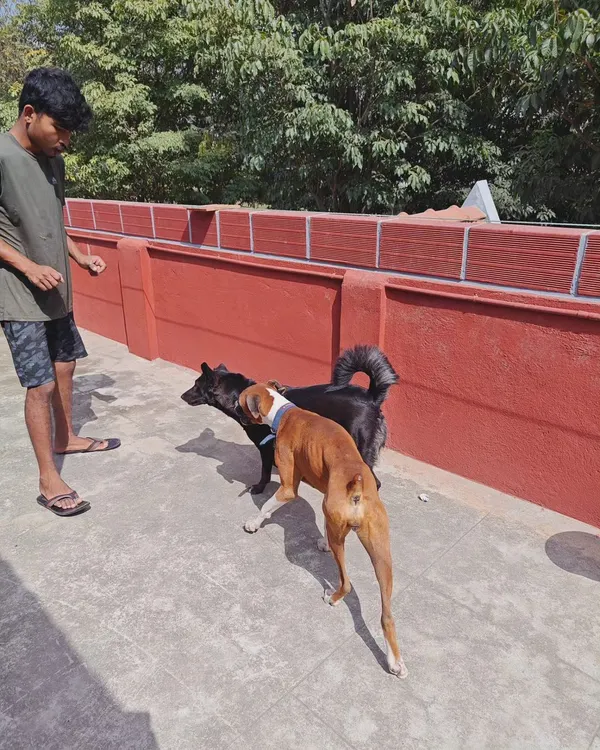
A moment of calm connection on the terrace. This shows an indie dog, a golden retriever, and a boxer sharing space respectfully after a play session.
A golden retriever and a German Shepherd mid-play on the rooftop. Learning to read each other's energy is crucial for healthy dog friendships.
A German Shepherd invites a Boxer to play. This kind of positive interaction helps build confidence in more timid dogs and teaches energetic dogs to moderate their approach.
About The Art of Socialization: Learning in a Pack
I do not teach your dog to be a robot. Instead, I let my resident Brat Pack do the heavy lifting. When a puppy or a shy rescue joins, they are not forced into drills. They shadow calm, balanced mentors who show them how to greet, where to sniff, and when to just chill out. This is real-world socialization, not classroom theory.
Socialization is often misunderstood as just 'letting dogs play'. True social learning is far more nuanced. It is about emotional regulation, reading body language, and understanding when to back off. My approach in Tharabanahalli is centered on creating an environment where dogs feel safe enough to communicate.
Why Pack Learning Works
Dogs communicate with micro-movements, shifts in posture, and scent. When a human tries to micromanage every interaction, the dog stops reading other dogs and starts waiting for instructions. My resident pack acts as a natural buffer. They teach new arrivals that it is okay to sniff, okay to ignore another dog, and okay to walk away from high-energy situations. This is vital for:
- Puppies: They learn bite inhibition and play boundaries from older dogs who actually have patience.
- Rescue Dogs: Many of the dogs I work with come from isolation or traumatic backgrounds. Being part of a stable, calm pack helps them decompress and realize they do not need to be in a constant state of defense.
- Reactive Dogs: We use long-leash walking and controlled exposure to help dogs who struggle with excitement or fear. By keeping the space open and the interactions meaningful, we lower their cortisol levels naturally.
Everything happens in our home environment, not a sterile facility. Whether we are hanging out on the terrace or walking through local trails, the focus is always on letting the dog make choices. If they want to play, they can. If they want to sit and watch the world go by, they can do that too. This sense of agency is the fastest way to build a confident, well-adjusted dog.
Similar work from other experts
Browse through Curated picks from other experts on mytribe
Socialization and Playtime at Wagg City
Canine Socialization and Supervised Play in Bengaluru
 19
19
Cage-Free Dog Boarding and Socialization in Bengaluru
 13
13
Dog Socialization and Cage-Free Play
Supervised Group Play & Socialization for Dogs in Bengaluru
Cage-Free Dog Socialization and Daily Play in Bangalore
More from Dog Training & Behavior Modification by The Urban Dawg
More services by The Urban Dawg