Architecture for Community and Social Impact
We build spaces that serve people, from rural classrooms to community centers. Our focus on hyper-local materials and collaborative design creates environments that are both functional and deeply meaningful.
Shadow play at the Talaricheruvu Rural School. The bamboo canopy and perforated jaali walls create a constantly changing pattern of light, making the space dynamic and engaging for the children.
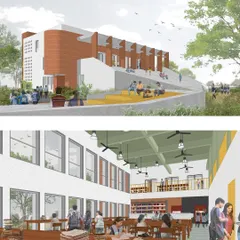
A classroom at the Talaricheruvu Rural School. We used simple, cost-effective materials and design features like geometric jaali screens to create learning spaces that are bright, well-ventilated, and joyful.
The classrooms are designed with large windows and jaali screens that allow for cross-ventilation and balanced natural light, creating a comfortable learning environment even in a hot climate.
The climate in Talaricheruvu can reach 48 degrees Celsius. The extensive canopy, made from over 12,000 locally sourced bamboo poles, provides crucial shade and respite from the summer heat.
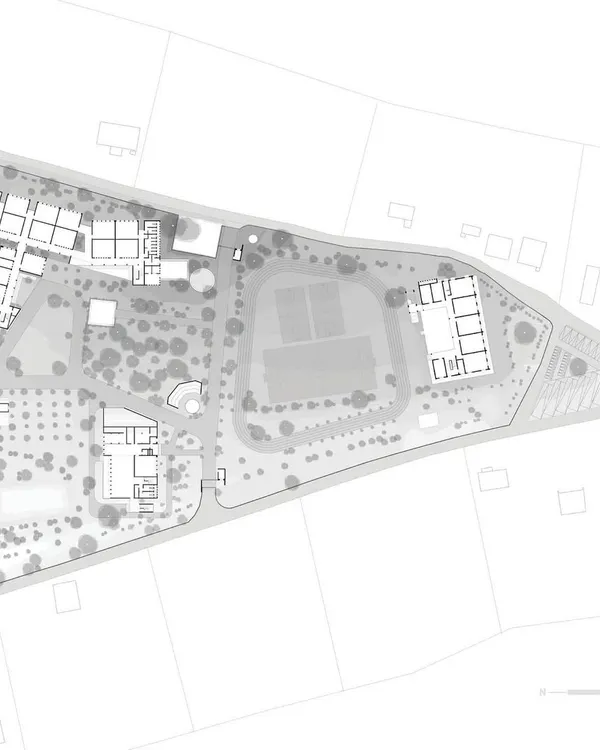
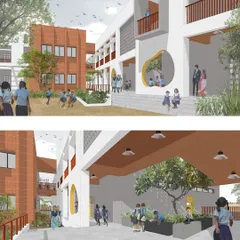
The undulating bamboo canopy connects the old and new school buildings, creating sheltered outdoor corridors and informal learning spaces where students can study or relax.
A lovely moment at the rural school, where students use new water taps outside the cafeteria. We focused on creating functional and dignified spaces for all aspects of school life.
Children playing and learning in the shaded corridor of a new pavilion at the Talaricheruvu Rural School. The design provides a variety of spaces for both formal and informal activities.
In addition to renovating the existing structure, we added a series of learning pavilions. Each pavilion features a colourful planted roof, which provides additional thermal comfort and a touch of nature.
An aerial view of the completed Talaricheruvu Rural School, showing how the new bamboo canopy weaves between buildings and over lush pockets of bougainvillea.
A view into a classroom through a playful jaali screen made of geometric shapes. These screens provide ventilation and light while adding a decorative element to the school's architecture.
About Architecture for Community
When designing the Talaricheruvu Rural School, we addressed the intense 48-degree summer heat without using energy-intensive cooling systems. We engineered an undulating bamboo canopy using 15,000 poles sourced via local government forestry programs. This structure does not just provide shade, but it effectively doubled the school's usable area, allowing children to learn and play comfortably in airy, shaded corridors even at the peak of the day.
Our approach to community architecture is driven by the belief that good design should be accessible, regardless of the budget. For the Talaricheruvu project, we didn't just want to build classrooms; we wanted to improve the daily life of the students.
We worked directly with neighboring village labor, training them to apply simple cement plaster finishes. This kept construction costs low while ensuring the economic impact stayed within the community. The geometric jaali screens are more than aesthetic; they create cross-ventilation, balancing natural light while keeping the interiors cool.
Seeing the school go from a 20,000 sq. ft. facility to 40,000 sq. ft. of usable space, centered around bougainvillea-filled courtyards, reminds us why we design. Whether it is a school, an office, or a community hub, we treat every project as an opportunity to test how materials like bamboo and recycled stone can create lasting, joyful spaces that truly belong to their context.
Similar work from other experts
Browse through Curated picks from other experts on mytribe
 45
45
Educational & Community Spaces
 4
4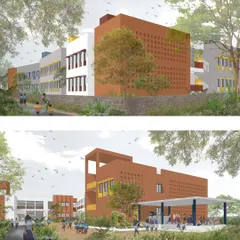
Community and Institutional Architectural Design
Purpose-Driven School Architecture and Community Spaces
 6
6
Designing for Education & Community: Spaces for Learning
Educational and Community Architecture in Bengaluru
 7
7
Sustainable Architectural Design for Learning Spaces
More from Architectural Design by CollectiveProject
More services by CollectiveProject